email: l8nightpickwick@gmail.com
When it comes to watching movies, October – for me – is for horror movies: A Nightmare on Elm Street (1984), Friday the 13th (1980), and – obviously – Halloween (1978). The classics.
But I’ll also go in for more contemporary fare: Talk to Me (2023), Barbarian (2022), and Host (2020). I’m a fan of the old school firecrackers when it comes to horror films, so I dig the bells & whistles of more recent scary movies.
In a similar fashion – where I live – the 4th of July is all about fireworks. You’ll hear the explosions of firecrackers & bottle rockets & Roman candles for the entire week leading up to the holiday, and you’ll hear the explosions of firecrackers & bottle rockets & Roman candles a few days later. It’s mostly annoying to me & absolutely terrifying to the animals living in the immediate area.
So – cinematically – when the 4th of July rolls around, you have your fans of Live Free or Die Hard (2007), Independence Day (1996), and The Sandlot (1993), but the joy — and terror — of fireworks shouldn’t be confined to an annual carnival or the Fourth of July.
There’s a certain terror to blowing off a finger with a rather inexpensive explosive that remains peak entertainment. I can’t think of a better image than marrying the thrill of a fireworks display with horror, because October shouldn’t inspire fear by monsters alone.
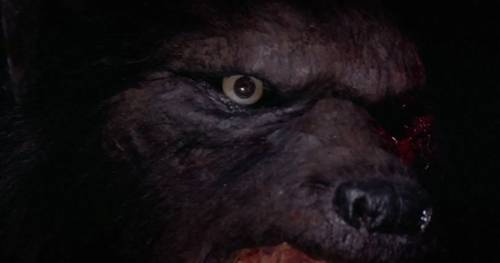
And Silver Bullet – based on Stephen King’s 1983 novella Cycle of the Werewolf – should rest on everyone’s 4th of July watchlist, alongside all of the more traditional motion pictures that celebrate fireworks & patriotism & appendage-endangering moments of fun – because Silver Bullet possesses just enough of that wonder to also be as terrifying as the holiday is to household pets.
The motion picture is the story of Marty (Corey Haim) – a paraplegic confined to a wheelchair in Tarker’s Mills, Maine. There, Marty spends his summer days with his best friend Brady & contending with his family, which includes his older sister Jane (Megan Follows), but when gruesome murders are committed in the small town — murders that Marty suspects are being committed by a werewolf — his small town will be rattled to its core, so much so that the autumn festivities, including the fireworks display, are canceled.
But Marty’s uncle Red (Gary Busey) has different plans. “You’re gonna have the 4th of July,” he tells Marty as he gifts him a king’s ransom of fireworks, in the wake of the fireworks cancellation, “but you’re gonna have it in September.” His homespun apology for the absence of a fireworks extravaganza is just what Marty needs to raise his spirits, but the young boy’s nocturnal celebration puts him in direct contact with the nocturnal monster itself, when the Tarker’s Mills Werewolf discovers Marty in the midst of his late-night fireworks display.
Now, only Jane & Uncle Red support Marty in believing that a supernatural monster exists in Tarker’s Mills, and only this trio might ferret out the local monster’s true identity.
And while at the heart of Silver Bullet rests a heart-stopping werewolf picture … even a compelling Whodunnit … what also beats within the chest of this film is — well — heart, because this particular movie remains interested at all times not only in telling the tale of a werewolf terrorizing a small town community but also in telling the story of an authentic, contemporary family.
As Marty’s older – and much more mature – sister, Jane has served as Marty’s appointed keeper for as long as she can recall, held back from everyday independence & teen life, like dating the cute boys at school because she’s expected to look out for Marty, who frankly requires little help. Add to this strained relationship the alleged werewolf attack on Marty’s life and – suddenly – Jane’s role as Marty’s reluctant guardian now has mortal implications. Even when Marty enlists Jane’s help in canvassing Tarker’s Mills in order to discover the werewolf’s true small-town identity, she does so begrudgingly, spending an entire day in what appears to be a fruitless investigation.
Meanwhile, Marty’s other ally – the third investigator in this trio of detectives – is Uncle Red, as alcoholic & carefree as he may be. Never fully in a cloud of distraction because of his substance abuse, Red’s drinking serves more as a metaphor for his adult immaturity than as a literal addiction, while his own relationship with Nan – Marty’s mother – mirrors the relationship between Marty & Jane.
Despite his drinking, Uncle Red possesses a functionality that allows him to survive in the world, just as Marty’s wheelchair never prohibits him from surviving in the world.
Uncle Red maintains the ability to not reach for a drink, evidenced as he suppresses the urge to do so at Brady’s funeral. But Red’s psychology is more empathetic to Marty & Jane. (Jane is so easily frightened by a garter snake, and Marty plays upon her fears by allowing Brady to dangle one in front of her face.) Marty (moreso) & Jane (with caution) possess an imagination that makes them susceptible to believing in werewolves, a belief that somehow must “age out” over time, until you’re old enough to seem more like Uncle Red.
Once capable of moving mountains despite your disability, the young, would-be heroes like Marty inevitably grow up to become the quietly criticized, alcohol-addled Red – past his prime & his ability to dream more for himself & ultimately more harmless than a young boy meant to spend the rest of his life in a wheelchair.
And Marty’s situation is made ever more difficult when it seems that no one will believe his story of a werewolf in Tarker’s Mills, except for Jane.
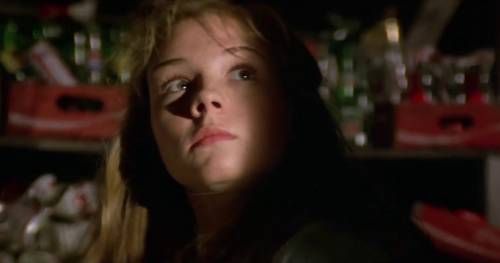
“If we tell anyone — grown-ups, I mean,” Jane begins, speaking of her newfound belief that a werewolf exists in their small town, “they’d laugh. What are we going to do?”
And yet the two share a faith that has never been fully lost by Uncle Red, when he tells sister Nan that Marty should not be reduced to his dependence on a wheelchair, that Marty possesses as much wherewithal as most people who can walk upright.
But if Uncle Red could have faith in the kids’ fervent belief that Tarker’s Mills is in danger, that the two of them alone are in mortal danger, Uncle Red might recapture some of that youthful faith that most young people inevitably lose: that monsters can lurk under a child’s bed, waiting patiently for the adult to leave the room.
“Jane, you don’t believe this madness, do you?” Uncle Red asks as the Three Investigators stake out the werewolf’s human alter ego in broad daylight.
“I don’t know exactly what I believe,” Jane replies after a moment’s hesitation. Meanwhile, Marty & Uncle Red stare out the windows of the car – one expectantly hopeful & the other almost entirely skeptical – in order to determine if their alleged suspect is capable of transforming into a wolf-man when the moon is full. “And I believe Marty,” Jane adds. “You used to believe in him too, Uncle Red.”
“Kids,” Uncle Red says, more to himself than Marty & Jane in that automobile, admitting that his disbelief in werewolves isn’t entirely warrantless.
And in that one word, he positions himself as the only obstacle between their belief in a monster & any vestige on the part of the audience that monsters are kids’ stuff.
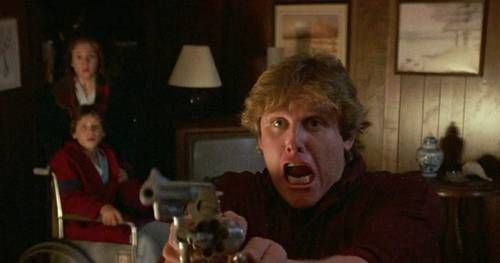
Quietly & ever so subtly, Jane has faith in this moment in Marty’s strength that the audience never imagined that he was without. And just as the motion picture’s climax nears, the audience also understands that Marty needs an assemblage of heroes in order to defeat this thing, and Uncle Red will need to begin believing.
And that particular bit of teamwork came from the home, leading to a late-night showdown where family is stronger than the monsters – real or perceived – that threatens to take our mortal lives …
… That especially threatens our relationships with one another, and one threat is neither greater nor lesser than the other, because one of those monsters doesn’t demand that you manufacture a silver bullet in order to defend your life.
Defending your family against the erosion of the family dynamic simply requires a faith that – until the movie’s final scene – some families don’t possess: on the 4th of July, on Halloween, on any day of the week.
And that is a true horror story.
No matter the day of the year.
* * * *
Silver Bullet is streaming on YouTube.

Chris Kaine is the most amateur film essayist whom you may ever imagine. He earnestly contends that he was named after the actor Chris Sarandon, because he was either conceived while his parents watched Fright Night (1985) in his paternal grandparents’ basement, or because of their love for The Princess Bride (1987), which stars a character by the name of “Humperdink,” which is pretty funny, if you think about it.


Leave a comment