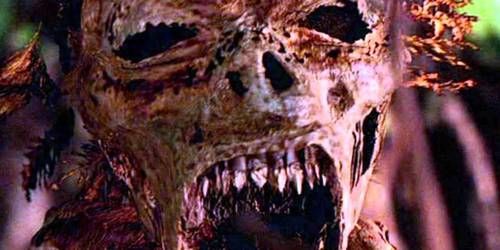
email: l8nightpickwick@gmail.com
2001 | PG-13 | 130 minutes | d. Stephen Sommers | dp. Adrian Biddle | s. Stephen Sommers
In this multi-part series, the Drive-In examines sequels that one may have seen before the original film or films — even the remakes or reboots — that came before it. Imagine seeing Toy Story 5 (2026) before any other Toy Story film — one would think that Jessie was the focal point of the entire franchise. See Scream (2022) before any other Scream film — and one would ask who final girl Sidney Prescott was in the first place. That’s where the Pickwick feasts on film.
Here, the Drive-In explores the second (or 3rd or 4th or 5th … ) chapter of a motion pictures series, holding it up to the movie(s) that came before it, taking a close look at how the series got here ...
… And, sometimes, where it was all headed.
This month, the Pickwick unwraps Universal Pictures’ 2001 sequel The Mummy Returns, the follow-up to the 1999 motion picture reboot The Mummy, the film that resurrected this bandaged villain franchise.
The Mummy’s Return is by no means the best picture in the monster’s filmography, but it remains an indelible footprint in the sand of the character’s storied history.
By the time that I discovered Hollywood had at some point gotten around to retelling or re-inventing or updating the narratives behind the Universal Monsters, I’d already settled upon My Big Three & in this order: the Creature from the Black Lagoon, the Wolf Man, and Dracula. And despite the retelling or re-inventing or updating, I initially had very little interest as a young moviegoer to actively seek out the countless cinematic iterations of My Big Three.
I saw Teen Wolf (1985) when I was 13, because – well – I was 13, and my uncle showed me An American Werewolf in London (1981) when it was still not age-appropriate for me, and I love it anyway (even if it’s a comedy, not even close to the tragic story of Lon Chaney, Jr., & his furry alter ego. And for a long time, I had little interest in seeing Jack Nicholson’s Wolf (1994). Even upon seeing it sometime later, I still have little interest in Jack Nicholson’s Wolf. Where Dracula was concerned, I wouldn’t have seen Nosferatu (1922) or The Horror of Dracula (1958) as early in my life as I did had I not read so much about them in horror encyclopedias & online discourse. And I enjoyed Bram Stoker’s Dracula (1992) well enough, despite some of its melodramatics. It’s not a Dracula film that I revisit often today. And I didn’t seek out Dracula 2000 (2000) for a moment or more – though I find its origin story for Dracula incredibly engaging. And as for the Creature from the Black Lagoon? I would have to wait until 2017 to see a legitimate film interpreting that member of My Big Three. And I loved it. Loved it for the romance, loved it for its portrayal of human men as the real monster, loved it for being a love letter to film.
I was rather shocked, then, when I discovered that Universal Pictures would resuscitate the Mummy. (Check out last month’s First, We Have Seconds feature about The Mummy’s Hand (1940), then come on back.) I saw the sequel before the original. My mom rented it from Blockbuster when I was 12, announcing that: a) she felt that I could handle the film at the age of 12, and b) she had seen the original 1999 film while on a date with some guy while my grandparents watched over me. (As Mom loaded the DVD into our living room player, she was not then aware that I’d already seen An American Werewolf in London with my uncle.)
I was a bit reluctant then to watch a sequel before seeing the original.
Imagine seeing Episode V before seeing Episode IV. Imagine seeing The Return of the King before seeing The Fellowship of the Ring. My imagination brings tears to my eyes.
I didn’t want to go into the movie not knowing anything. But I did – once more – with The Mummy Returns.
What I know now is that the motion picture – once more written & directed by Stephen Sommers – picks up some nine years after the first film’s adventure. This wasn’t difficult to suss out. After the defeat of the Egyptian High Priest Imhotep (Arnold Vosloo), Rick O’Connell (Brendan Fraser) & his wife Evelyn (Rachel Weisz) have been gallivanting across the globe with their young son Alex (Freddie Boath) – and the kid is clearly a chip off the ol’ block – and while in Egypt discover the Bracelet of Anubis. Upon returning to London with their mysterious treasure, the Bracelet attaches itself to Alex’s arm. And once affixed to Alex’s wrist, the Bracelet cannot be removed, giving Alex a seven-day deadline to reach the golden pyramid in Ahm Shere before the morning sun shines upon it. At that moment, the bracelet will take Alex’s life & soul. So aided by Evelyn’s fast-talking, philandering, trouble-attracting brother Jonathan (John Hannah) & Oded Fehr (Ardeth Bay), and others, the O’Connells are dead-set on arriving at Ahm Shere within seven days, while a cult intent on using the Bracelet to resurrect the High Priest Imhotep remains in deadly close pursuit.
But what one doesn’t know about The Mummy Returns upon the first viewing may be as daunting as the O’Connells’ mission to Ahm Shere.
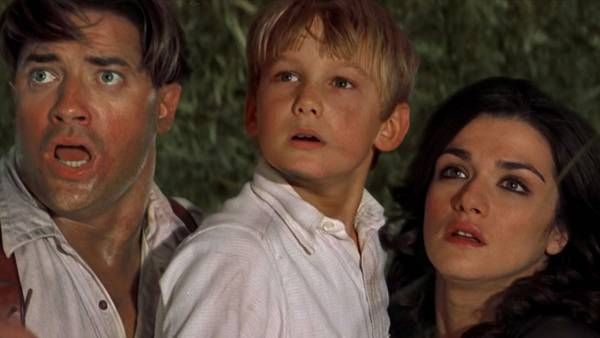
I – for one – knew nothing of the actors when I first saw the film. I would meet them all again when I saw The Mummy (1999), but they were otherwise as alien to me as Egyptian mythology when I first saw Returns. Later, I would “discover” Fraser in With Honors (1994). I would see again Weisz as John Constantine’s hard-headed investigative partner in the supernatural thriller Constantine (2005). And I would be ultimately charmed by Hannah when I saw him as one-half of a brilliantly charming gay couple in Four Weddings and a Funeral (1994). Yet when I later saw the original 1999 motion picture, Fraser seemed to step out of a 1940s serial and onto the quote-unquote big screen, the heir apparent to widescreen heroes like Allan Quatermain, Doc Savage, and Indiana Jones. Sommers’ Mummy films endure this particular sensibility, even when they don’t survive other quicksand missteps.
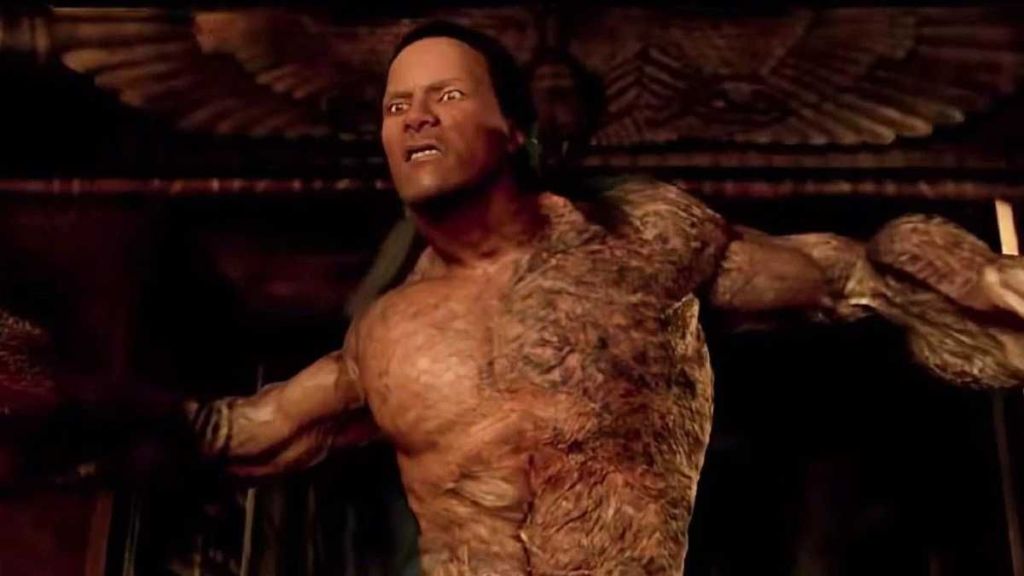
One must always contextualize a film when discussing it, and to write that the CGI in The Mummy Returns doesn’t age well isn’t necessarily fair. The film is a product of the turn of the century, but an obstacle arises in almost every film that marks it as imperfect. Then, exorbitant costs & technical limitations led Dwayne “The Rock” Johnson’s CGI role as the Scorpion King to look like little more than a non-playable character in a video game, unrecognizable as Johnson unless one understood that the Scorpion King was, in fact, the Rock – with a face as dead as one made of stone.
And what one might not know is that a Mummy movie sequel (according to Universal’s 1932 original & 1940 sequel) seeks at least a little (and, sometimes, a lot) of humor. Sommers’ 1999 origin story of this rebooted franchise was never intimidated by its own Romancing the Stone-inspired humorous charm — in fact, The Mummy Returns leans into it, sometimes even (grave)robbing the picture of any true peril.
Yes, The Mummy Returns hits the ground running in establishing its central conflict & illustrating some engaging action, but within 30 minutes of the film, Returns plays like a movie that one would see during the month of October on Freeform, a horror picture perfectly sandwiched between Hocus Pocus (1993) & The Haunted Mansion (2003), an entertaining if innocuous Sunday afternoon screening during the spooky season.
So when threatened by a bandaged, slow-moving monster in The Mummy (1932), perhaps The Mummy’s Hand infused sometimes awkward, ill-placed levity in order to elevate the motion picture. But humor didn’t improve upon the original film’s tone, pacing, or intent. The sequel did little more than task moviegoers to ask themselves if they were watching a legitimate horror movie or a cheeky creature feature. And, perhaps back then, the humor infused into horror movies was simply another attempt at providing audiences an escape from the real world horrors of the Great Depression.
Meanwhile, The Mummy (1999) is not without its share of tomfoolery, and that’s the point – so long as no one is looking to revisit the mildly unsettling dread of the original 1932 motion picture. Gargantuan book shelves collapse in a domino-like display, Evelyn’s brother Jonathan brings his roguish charm to the solemnity of the museum, and Rick O’Connell hangs from a rope by his neck for such an excruciatingly long time that it would kill a human being outside of the cinematic world.
But Sommers’ Mummy franchise is neither interested in the strict logistics of human physiology nor the trappings of what made Universal’s 1932 horror movie so mesmerizing. And moviegoers who will accept those parameters will have little trouble accepting the conditions of The Mummy Returns, lest the narrative unravel altogether.
Perhaps the Mummy franchise of the 21st Century demands a bit of humor. Perhaps the ominous yet slow-moving mummified corpse isn’t enough to bring audiences to the theaters in the 21st Century.
Perhaps it needs an immediate love interest in the O’Connells tracking a mummified corpse to its resting place. Perhaps – through young Alex – it demands a Dennis the Menace-like child to run his parents’ archeological dig off the rails. And perhaps it needs the buffoonery of a charlatan brother slash brother-in-law who will inevitably gum up the works. If these ingredients constitute The Mummy Returns, the motion picture wasn’t “returning” to the big screen with many of these ingredients …
… The Mummy Returns was simply unearthing new treasures, whether uniquely precious or unusually paltry.
* * * *
The Mummy Returns is streaming on Peacock.

Chris Kaine is the most amateur film essayist whom you may ever imagine. He earnestly contends that he was named after the actor Chris Sarandon, because he was either conceived while his parents watched Fright Night (1985) in his paternal grandparents’ basement, or because of their love for The Princess Bride (1987), which stars a character by the name of “Humperdinck,” which is pretty funny, if you think about it.


Leave a Reply