email: latenightpickwick@gmail.com
Halloween may have come & gone, but November is never too late to celebrate some cinema that sees the specter of Death nipping at one’s heels. This month, the Pickwick looks back on films from the year 2006, at the movies for which the Drive-In remains very thankful.
When it comes to horror, all of the greatest cinematic icons – like cream – float to the top of the discussion. All B-listers are forgotten. If you want to discuss slashers, Michael Myers, Jason Voorhees, and Freddy Krueger ultimately rise to the surface. When you want to discuss monsters, it’s all of the heavy hitters from Universal Pictures: Dracula, Frankenstein’s Monster, and the Wolf Man. And if you want monsters bigger than that, Godzilla rises above all others. Perhaps Gamera is present in the conversation, but Mothra is only a guest star, and Cloverfield is grossly overlooked as the star of its own film.
But there’s a special place in the hearts of horror fans for creature features, those motion pictures starring malicious miscreants in drive-in-level filmfare that lacks the alleged motive of slashers & the audience’s sympathy for the tragic Universal monsters doomed to hurt those around them.
No, we’re not talking about the likes of Leatherface nor King Ghidorah but about the giant, irradiated ants that threaten the nation in Them! (1954); the gargantuan arachnid that wreaks havoc in the movie with the very simple title Tarantula (1955); and even the villainous vegetables in Attack of the Killer Tomatoes (1978). The Pickwick is interested now in creatures — the creepy, crawly kind.
Perhaps the Pickwick has surveyed the wrong moviegoers, but some find it difficult to articulate what makes creature feature motion pictures so alluring. The movies might be so bombastic in their monsters, so ill-worded in their plot explanations, that there’s something endearing about them, even on a remedial level. These movies seem to scratch a certain itch of nostalgia: the trope of the small town invaded by a seemingly unstoppable horde of … whatever … revives memories of unspeakably ridiculous motion pictures that simply recapture what was once fun about watching movies on the big screen or the small TV screen late at night on a Friday evening.
But what today’s creature features of the past few decades – The Descent (2005), A Quiet Place (2018), and Nope (2022), to name only a few – demonstrate is that this subgenre of horror isn’t going anywhere. It’s here to stay. If creature features are going anywhere, they’re coming home. And they’re staying there.
My first creature feature was Gremlins (1984), shared with me by my uncle. As we watched it together, I distinctly remember seeing him from the corner of my eye, as he watched for my reaction to that microwave moment. Those moments thrilled my uncle, when he could share them with me. Understand that I was still doing cartwheels over E.T.: The Extra-Terrestrial (1982) when my uncle sold me on watching Gremlins – a movie produced (not directed) by Steven Spielberg – about another breed of creatures that found itself in a suburban neighborhood. My uncle had already taken great joy in introducing me to E.T. in a dark cornfield, wailing, a bestial thing. Now, he would introduce me to demonic creatures that somehow produced comedy in their mayhem of a small town much like mine.
Horror sometimes depends upon the intimacy of a tiny, vulnerable community.
And — sometimes — only wriggly creatures will scratch that particular itch for bygone cinema.
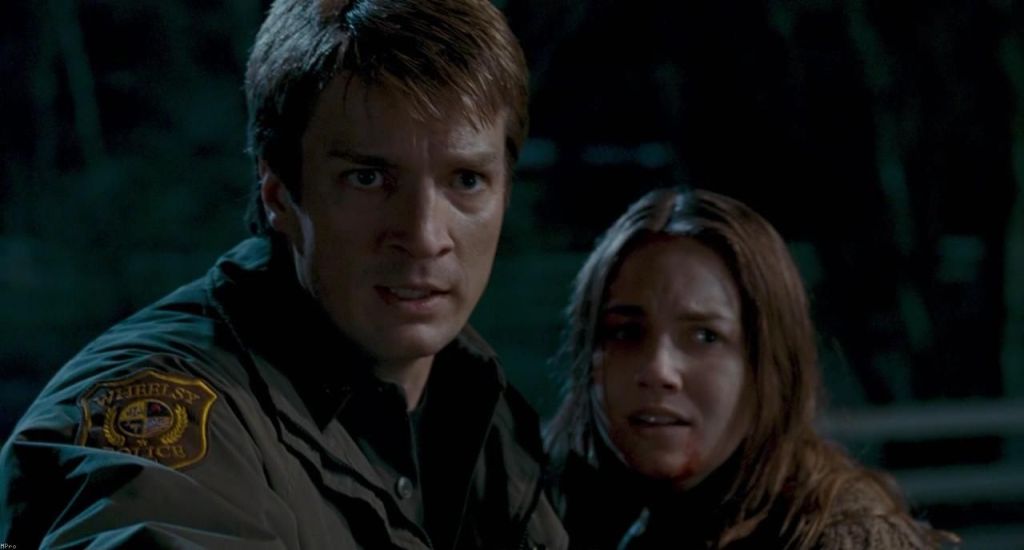
Written & directed by James Gunn and starring Nathan Fillion & Elizabeth Banks, Slither satisfies both intentions.
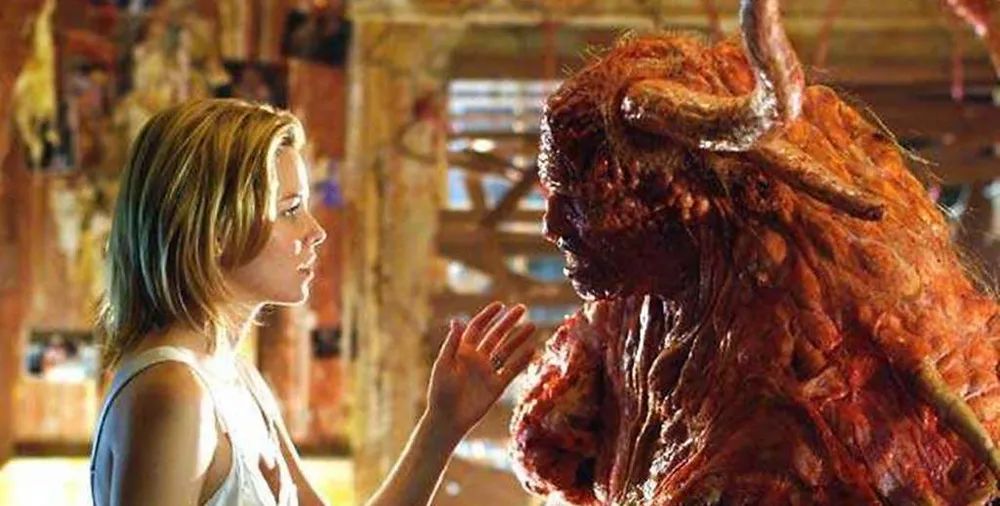
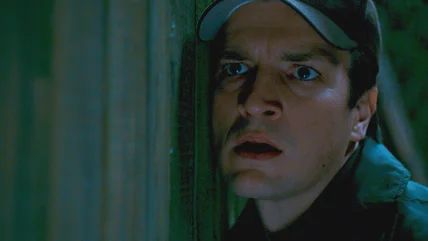
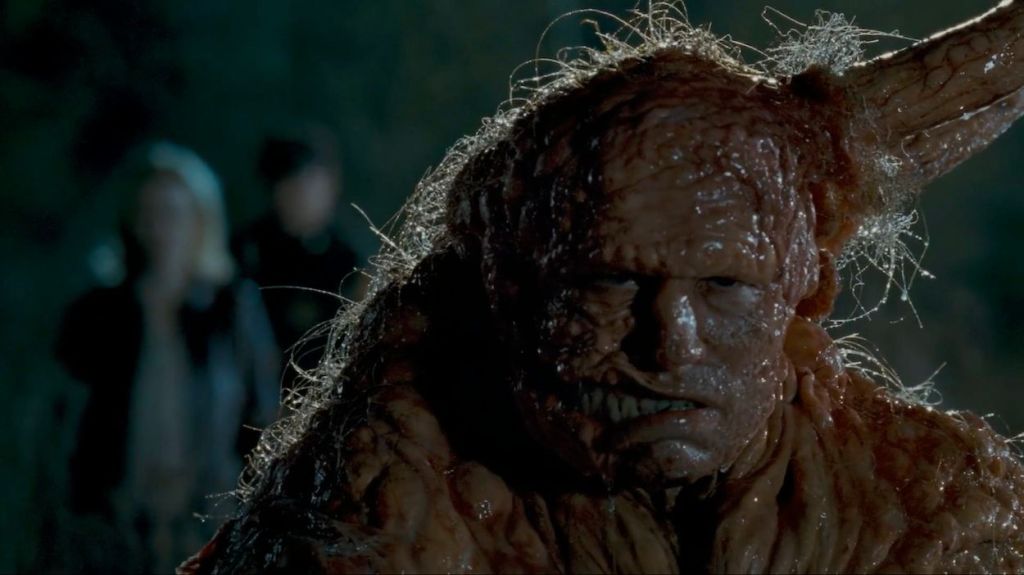
The motion picture is the stuff of drive-in movie theater popcorn legend, the sort of film that would constitute an event that one would not want to miss as a midnight screening in a small town, which is precisely where the movie takes place: in the small town of Wheelsy, South Carolina, where everyone has known everyone (including their personal business) forever. But what no one seems to know is that a meteorite has brought a deadly, parasitic creature to Wheelsy, and the wealthiest man in town Grant Grant (Michael Rooker) is the thing’s host, quickly transforming his behavior & slowly turning him into a monstrous, tentacled thing. Assisted by Grant’s wife Starla (Banks), Wheelsy’s mayor (Gregg Henry), and a local teenager (Tania Saulnier), Wheelsy’s Police Chief Bill Pardy (Fillion) must discover a way to thwart the alien parasite once everyone else in town appears to be hosts of alien larvae, before Wheelsy becomes a home for the hive-minded creatures.
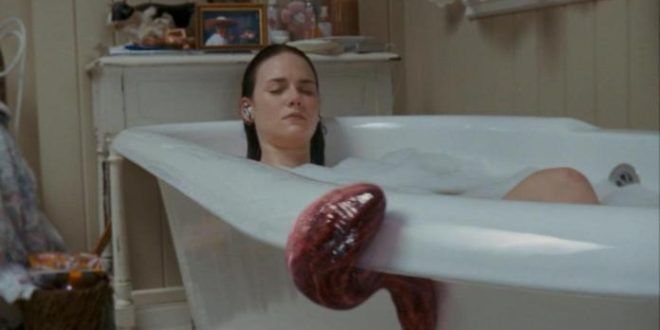
In preparing this particular piece, it took a total of three screenings to determine what makes Slither work as well as it does, for me. As a Friday night feature, there’s nothing uniquely proprietary about the film’s premise – it could likely be mistaken for a remake or a reimagining of any number of like-minded science fiction horror films that graced drive-in big screens during the 1950s or early 1960s.
In fact, Slither comes from an original screenplay penned by Gunn himself. And though Slither shares its DNA with 1950s drive-in fare, its Gunn’s universe, period. (The writer-director would have more than enough time later to re-envision popular IP like Marvel’s Guardians of the Galaxy (2014 – 2023) or DC Comics’ Superman family (2025 – present). And Gunn’s motion picture wasn’t the first to creatively & originally recreate genre tropes. Today, Universal Pictures’ Tremors (1990) remains an astoundingly beloved piece of referential filmmaking, almost transcending its own cult classic status.)
And yet – in writing & directing a motion picture clearly inspired by drive-in cinema from 50 years ago – Gunn is, in fact, providing his take on intellectual properties that were ridiculously popular in post-WWII America. When it comes to Slither, Gunn was simply warming up with what would become a series of home run widescreen success with superheroes instead slithering slugs.
It’s one of the reasons why the Pickwick Drive-In selected Slither as one of November’s movies that deserves some thanks. Scary movies were entirely absent from October’s lineup, to be frank, and November is never too late to hunker up to horror.
But more than that, entertaining, effective homage films remind the viewer what made the first wave of that filmfare so enjoyable in the first place.
When I see a really good movie, I’m not one to press PLAY again in order to relive that film again, immediately. I know that I’ll return one day to that film, but there’s no time for that now. When I see a really good motion picture, I go wherever I need to go – the theater or a streaming service – to see for the first time another really good movie. That’s the dragon that I’m at all times chasing. When it comes to really good homage movies – True Lies (1994), Scream (1996), Black Dynamite (2009), Drive (2011), and more – I’m compelled to seek out the originators of those homage films – James Bond movies (1962 – 1989); Torso (1973) or Black Christmas (1974); Shaft (1971) or Foxy Brown (1974); The Driver (1978) or Thief (1981); and more.
But whether an homage movie or a brand new film, that compulsion is — one would hope — the intended reaction to really good motion pictures, even mediocre or terrible motion pictures:
Watch more movies.
I dated a woman who told me once that she loved movies. She loved a particular handful of live action Disney motion pictures from the 1960s. She loved a particular franchise of mystery films from the 1930s. And she loved Dick (1999). But that was all she loved. She didn’t demand new experiences, so didn’t seek out new films. She also loved, approximately, 10 films in total – she therefore didn’t seek out other films that could have anything in common with her favorite films.
“If you like Murder on the Orient Express,” I would suggest, “you may really enjoy Knives Out. You should check it out, maybe.”
She stared at me blankly, the kind of incredulous look one might give you when your principles were unnecessarily questioned by someone who should mind their own business.
“Why would I check it out,” she said quietly, deliberately, “when I know that I like Murder on the Orient Express?”
And I get it: the heart wants what the heart wants – and, it would turn out, my heart wouldn’t want her for long – but few true film fans could imagine closing themselves off from new films, nor the many potentially great films from years before. The Pickwick wouldn’t keep its doors open if it only rehashed a dozen or so motion pictures, and that’s what the Pickwick celebrates today: movies that ask us to seek out new movies or those we loved years ago.
The Drive-In can’t imagine not screening films that once meant so much to its viewers, even itself …
… Or could possibly – even probably – mean so much to a new audience of viewers.
* * * *


Leave a Reply