email: latenightpickwick@gmail.com
In this space, the Pickwick Drive-In examines motion pictures through which a singular artist played an important part, large or small. Four Seasons is an exploration of four films — four brief moments, like the seasons themselves: spring, summer, autumn, and fall, representing birth, growth, the passage of time, and finality — with the contribution of a unique star, whether in front of the camera as a movie star; playing a supporting role in the production’s cast; or behind the camera as a cinematographer, director, writer, and more.
This month, the Pickwick rolls back the celluloid reels to showcase only a few of the 200 films starring Diane Ladd, who was born in 1935 & passed on November 3rd, 2025. This brief tribute cannot capture the impact that Ladd had on the small & large screen.
Diane Ladd’s was a career — like many — that simply had to grow, and hers was a career that simply wouldn’t stop growing.
S P R I N G
A C T I O N / T H R I L L E R
* * * *
The Wild Angels
1966 | R | 93 minutes | d. Roger Corman | dp. Richard Moore | s. Charles B. Griffith
* * * *
* * * *
There’s something to be said for the size of the part that you play in a movie, even in the world. William Shakespeare wrote that there are no small parts – only small actors, and yet the impact one makes in the world, even in the movies, says so much more.
And the career of Diane Ladd embodies that sentiment like few others.
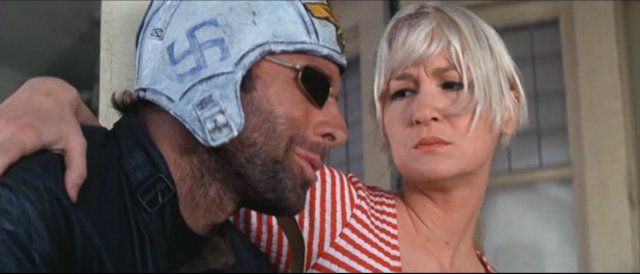
Having starred in two uncredited roles – Something Wild (1961) & 40 Pounds of Trouble (1962) – Ladd’s first credited role in The Wild Angels allowed her three unique opportunities that set the stage for what would be a decades-long career. The first & most charming detail is that the film gave Ladd a chance to star alongside her then husband Bruce Dern. The second is that the film offered her the chance to work alongside maverick director Roger Corman, who had already been making movies for almost a decade before The Wild Angels. And the final note is that Ladd played in a motion picture that would play a role in launching the counterculture cycle of biker films that would inevitably lead to the classic Easy Rider (1969) – which also starred Peter Fonda – and thrived through the early 1970s.
And while Ladd’s first credited role was a supporting one in nature, it was not only pivotal to the conflict of The Wild Angels but also wildly significant in Ladd’s private life & her place in filmmaking.
In The Wild Angels, a San Pedro motorcycle gang, led by Heavenly Blues (Fonda), head out in search of a stolen motorcycle owned by one of their members named Loser (Dern). Encouraged by Loser’s lover Gaysh (Ladd) to seek retribution when Loser is killed in a brawl that leads to law enforcement interference, Blues sets out on a self-destructive course of vengeance & tribute in the name of his fallen friend Loser.
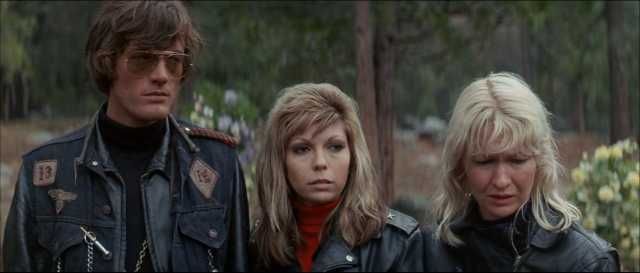
The Hell’s Angels were central to The Wild Angels, so few could anticipate the immediate consequences of a movie that not only emulated the alleged behaviors of the Hell’s Angels but also starred Hell’s Angels bikers in order to maintain the motion picture’s authenticity. Crooner Frank Sinatra was allegedly skeptical of the project, asking if his daughter Nancy should star in a film of this kind. Because there remains something dangerous in making a movie that involves the Hell’s Angels, but examine the history of filmmaker Roger Corman (1926 – 2024), and one would recognize that there was something dangerous about him too.
Perhaps it’s natural, then, that Ladd’s career ultimately began as it did, in the sorrowful wake of Gaysh’s dead lover Loser, but – as an actor – Ladd would blaze a trail that defied a pedestrian approach to the craft of moviemaking.
Peter Fonda’s Blues interrupts Loser’s funeral service by calling out, “We want to be free. We want to be free to do what we want to do.
“We want to be free to ride. We want to have a good time,” Blues continues. “That’s what we’re gonna do. We’re gonna have a good time.”
And those words – though spoken at the end of Loser’s life – could just as easily been spoken at the beginning of Diane Ladd’s career:
One that was defiant, one that would not be confined, one that would travel sun-scorched, bruised highways …
… One more interested in the journey than the destination.
* * * *
* * * *
The Wild Angels is streaming on Tubi.
S U M M E R
M Y S T E R Y / T H R I L L E R
* * * *
Chinatown
1974 | R | 130 minutes | d. Roman Polanski | c. John A. Alonzo | s. Robert Towne
* * * *
* * * *
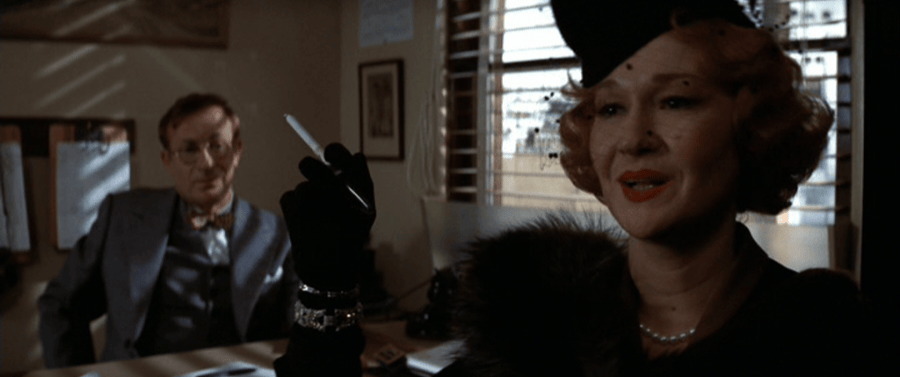
By the beginning of 1974, Diane Ladd may not have begun headlining in her films, but that wasn’t to suggest that she wasn’t playing a pivotal role in truly important motion pictures. In June of that year, Ladd would star in a movie that would go on to be nominated for 11 Academy Awards, including Picture Director, Actor (Nicholson), Actress (Dunaway), Original Screenplay, Cinematography, and more.
Chinatown would walk away that year with an Academy award for Towne’s original screenplay. Today, the motion picture still maintains a score of 98% on Rotten Tomatoes.
In the film, it’s 1937 Los Angeles, and private investigator J.J. “Jake” Gittes (Jack Nicholson) is hired by a woman (Diane Ladd) to trail her husband Hollis Mulwray (Darrell Zwerling) in order to obtain proof that he is having an affair. But when a) Gittes photographs Hollis with a younger woman, and b) those photographs expose Hollis when printed in the Post-Record newspaper, and c) Jake is confronted by the real wife (Faye Dunaway) of Hollis Mulwray, and d) Hollis’ corpse is suddenly discovered in a reservoir, “Jake” begins to understand that his original case goes much deeper than run-of-the-mill infidelities perpetrated by a local politician.
“Jake” may even discover that the second leg of this case is overwhelmingly & politically corrupt, a power that justice will never thwart.
One might even call it “Chinatown.”
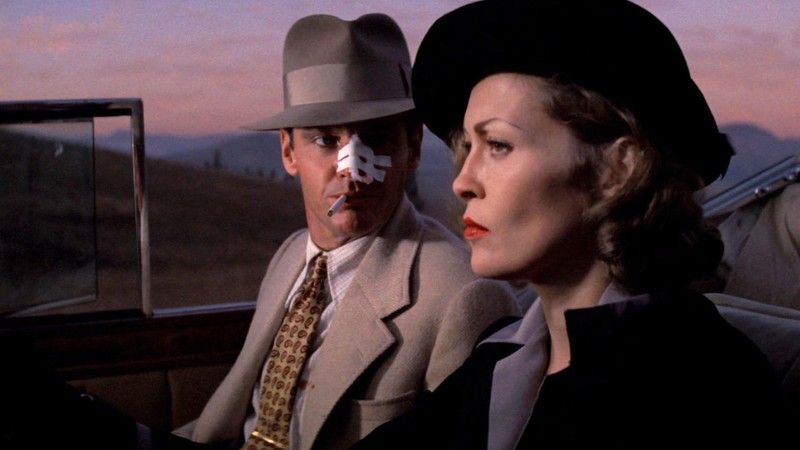
But if Chinatown intended to demonstrate that some circumstances will inevitably fall out of the purview of justice – that good will not always triumph over evil – the motion picture couldn’t have been produced in a more appropriate decade. By the end of March in 1968, the U.S. had orchestrated the My Lai Massacre, in which American soldiers killed hundreds of unarmed Vietnamese civilians, ultimately laying the groundwork for full anti-war & anti-government sentiment in the U.S.
Meanwhile, stagflation – the stagnation of economic growth – coupled with inflation – the increase of the price of goods & services – took its toll on American pocketbooks. And the Nixon-Watergate scandal contributed to an even greater distrust in American government, an almost universal 180 degree shift from the political optimism of the 1960s. Motion pictures of the early- to mid-1970s were simply a response to the disillusionment that everyday Americans were feeling toward many U.S. institutions.
Finally, the dissolution of the Hays Code in 1968 allowed Hollywood filmmakers to compete against television & foreign films, now able to tell stories that seemed altogether prohibited under the Hays Code. Without the code in place, the “reporting” of the very realistic contemporary world – in films like The French Connection (1971), The Godfather (1972), Serpico (1973), and othere — would likely not have been made were the Hays Code still in place. As bleak as its conclusion may be, Chinatown also would not be possible without the abandonment of the Hays Code, which held that good must always triumph over evil.
But the Hays Code was no more.
And: “It’s Chinatown,” as the motion picture announces in its final spoken line.
But if there’s a cynicism in Chinatown that would be revisited for decades in films like John Carpenter’s The Thing (1982), Fincher’s Fight Club (1999), the Coen Brothers’ No Country for Old Men (2007), and Dan Gilroy’s Nightcrawler (2014), then Chinatown is one of the original stomping grounds of a new zip code of Hollywood storytelling, where it was promised that the happily ever after doesn’t necessarily happen here.
And it would appear that American audiences were ready for it.
But for Diane Ladd, her career was not so much Chinatown as the Land of Milk & Honey, because Ladd’s star was on the rise in mid-June of 1974 …
… And it was a nice place to be for Ladd at that moment – but she wouldn’t be there for long, leaving soon for an entirely different neighborhood of success.
* * * *
Chinatown is streaming on MGM+.
A U T U M N
R O M A N T I C D R A M E D Y
* * * *
Alice Doesn’t Live Here Anymore
1974 | PG | 112 minutes | d. Martin Scorsese | dp. Kent L. Wakeford | s. Robert Getchell
* * * *
* * * *
On the heels of the nihilistic Chinatown, Ladd’s second film of 1974 represented a rather remarkable departure from the 1930s-based grit of Los Angeles, though it wasn’t without its sharp edges. Directed by Martin Scorsese – who was coming off the distrustful realism of Mean Streets (1973) – Alice casts both Ladd as an actor & Scorsese as a director in a new light.
Gone in Alice Doesn’t Live Here Anymore is the signature negativity of NYC 1970s streets, replaced instead by a romantic dramedy that for a moment separates Scorsese from unflinching criminality in film. It even transports Ladd from the amorality of Chinatown & the late-50s hedonism & hoodlums of The Wild Angels.
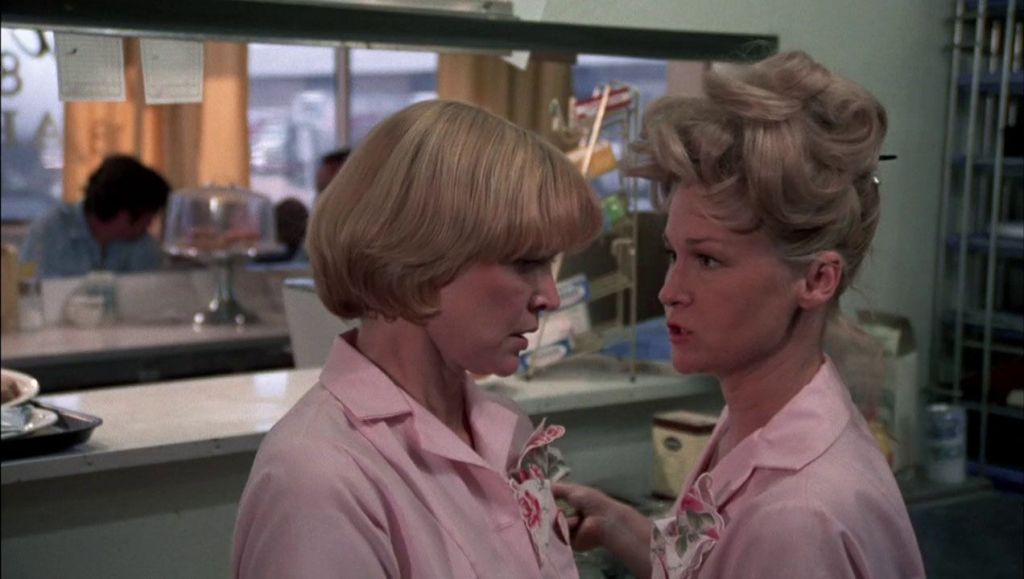
The film tells the dramedic story of Alice (Ellen Burstyn), a housewife & mother who – after the sudden death of her husband – sets out for Monterey, California, in order to realize her dream of being a professional singer. But upon being stranded in Tucson, Arizona, along the way, Alice takes a waitressing job at a local diner, staffed by the outspoken Flo (Ladd), among many unique others, including the proprietor Mel (Vic Tayback, who would reprise the role in the television series Alice (1976 – 1985), based upon Scorsese’s film). There, Alice meets an attractive local rancher (Kris Kristofferson) – whose relationship with Alice & her pre-teen son (Alfred Lutter) will challenge Alice’s journey in becoming an independent woman.
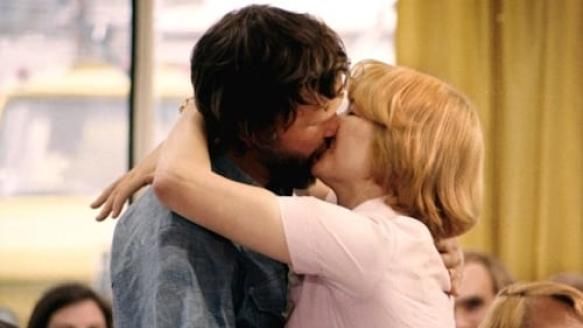
And yet, it must be strange that a film as female-forward as Alice would curate as many positive reviews as negative reviews from critics who cast the film as a piece of feminist cinema.
Many critics praised Alice Doesn’t Live Here Anymore for its portrayal of a strong woman in the throes of being a widow, of being a suddenly single mother, of being an aspiring woman in search of love. And just as many critics railed against the movie’s portrayal of a woman characterized as apparently incapable of making good choices: for her son, for her career, and especially for herself.
Those opposing forces — vocalized by the movie’s critics — remain always at the core of Alice. But, as her son Tommy tells Alice in the final moments of the film, “You always said you could fight with somebody and still like them.” There might not be a better commentary about the difference between fantasy & reality than that one.
After all, the opening credits of Alice Doesn’t Live Here Anymore capture the wanderlust romance of true love promised in so many movies of the late 1940s & 1950s. It was a different time in film, then, of course. And despite the cynicism that was beginning to percolate in 1970s cinema, Scorsese’s introduction to the film – reappropriating the dream-like hopefulness of MGM’s 1939 classic The Wizard of Oz as it did – looks like either a nod to Hollywood’s yesteryears or an ironic comment about the nature of contemporary romance. (Alice wouldn’t be the last time Diane Ladd would cross paths with the Wizard of Oz.) But perhaps it’s a bit of both: a marriage of the old Hollywood representation of love & the real-time character of it.
When I set out to tackle this particular film for this project, what stood out to me at first was that its subject matter would confront the life of a single mother. I was drawn to Alice for that reason, as the son of a single mother. According to one film summary, it was suggested that Alice would try to navigate the responsibilities of being an independent woman & a woman in love, simultaneously. That sounded intriguing.
But the second attractor was that Alice was billed as a comedy – or, at the very least, a romantic comedy. That sounded intriguing as well, because neither romantic nor comedy fit into my understanding of Scorsese as a director at that time. That ill-worded summary, I would find, meant that Alice wasn’t going to retrace the familiar steps of Mean Streets. It likely wouldn’t serve as a precursor to the themes of Taxi Driver (1976), which would be Scorsese’s next film. Anyone would have been right on both counts.
Alice Doesn’t Live Here Anymore lacks the starry-eyed bewilderment of bygone cinema yet also lacks an onslaught of laugh-out-loud moments that would characterize the motion picture as a comedy.
Admittedly, when Alice is romantic, it’s sweet & appropriately awkward, but there’s also something uncomfortable & imperfect about it, laced as it is with sexual promiscuity, violence, and even remarkable differences in parenting styles, as if Alice means to suggest to its audience that this is what romance (capital “R”) is in the world. And when Alice is funny – well – it too is sweet & appropriately awkward, and there’s something (lower-cased “u” & lower-cased “i”) uncomfortable & imperfect about it, almost as if – in 1974, when the film was released – this is what comedy was meant to look like in the world: funny but not ha ha ha funny.
And perhaps all of this is precisely the film’s point: that love is a many-splendored thing, but the Yellow Brick Road is often beset by automobile breakdowns, marital infidelities, flying monkeys, and a compromise that means that love is never perfect …
… but it’s Home.
And while imperfect, there’s nowhere else like it.
* * * *
Alice Doesn’t Live Here Anymore is streaming on YouTube.
W I N T E R
C R I M I N A L R O M A N C E
* * * *
Wild at Heart
1990 | R | 124 minutes | d. David Lynch | dp. Frederick Elmes | s. David Lynch
* * * *
* * * *
The Pickwick Drive-In would have to imagine that one’s appreciation of David Lynch has a great deal to do with where one first met David Lynch. For example: meet Lynch with his mind-bending 1977 horror film Eraserhead, and one might with an open mind accept what’s to come of the firebrand director’s divisive cinematic career.
But to this day, I have yet to have seen Eraserhead. When my mom introduced me to Michael Jackson, I spied in one of his music videos the King of Pop dancing with what appeared to be a skeleton whose was not only draped with a burlap sack but was also adorned with an elephant’s trunk. That weirdness was added to the small mountain of weirdness that I knew as Michael Jackson at that time & that led me to Joseph Merrick & that led me to Lynch’s The Elephant Man (1980), one of Lynch’s most non-Lynchian films, from what I’ve read. From Blue Velvet (1986) to Twin Peaks (1990 – 1992) to Mulholland Drive (2001) – none of which have screened at the Pickwick – everything that comes after The Elephant Man seems to play like a fever dream, like something imbued with an undying fire, like something with an irrepressible madness that lurks beneath the concrete cul-de-sacs of suburbia.
Everything that comes after early David Lynch naturally comes like something starring the likes of Nicolas Cage: early in his career yet at his most Nicolas Cage even.
Like Wild At Heart.
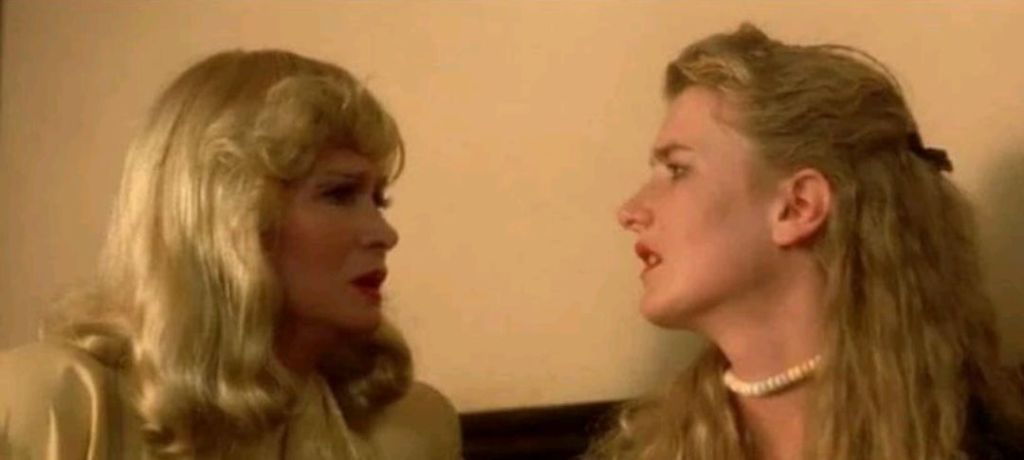
The film is the story of Hellbound lovers Sailor (Cage) & Lula (Laura Dern) determined to discover their Happily Ever After together, even if it kills them. Especially even if it means killing some other people. And when Sailor’s checkered past find him locked up for almost two years for killing a man in self-defense, his release from prison stokes the ire of Lula’s mother Marietta Fortune (Ladd), who responds by sending both her on-off private investigator boyfriend (Harry Dean Stanton) & her career criminal legitimate boyfriend Santos in pursuit of Sailor’s head. En route to California – which promises to be the end of the Yellow Brick Road for the couple, Sailor & Lula will confront a number of sexual, violent obstacles in their search of a dreamy ending.
“The world is wild at heart,” Lula tells Sailor as the motion picture Wild at Hearts puts the pedal to the metal, rocketing the film towards what could be its brutal, fiery conclusion. But, Lula adds, “and [the world is also] weird on top.”
Again, sometimes truth lies in a bit of duality.
Coincidentally, then, or ironically, or serendipitously, the melodramatic, Southern Gothic romance Wild At Heart has much in common with Alice Doesn’t Live Here Anymore, despite the fact that the cinematic stories are told by radically different filmmakers.
And – again – one of Ladd’s films references that fantastical journey of Dorothy to the Emerald City and – from there – Home. But the references here are much more obvious than those that appear in Alice. Here, an outright comparison of Marietta Fortune to the Wicked Witch of the West sets the film’s tone, while a poor brain-damaged victim of an automobile accident may appear to reference the brainless Scarecrow. Sailor’s own loyalty to Lula mirrors the devotion possessed by the little doggy Toto, while the anti-hero’s own naivete reflects a bit of the Cowardly Lion’s lack of courage – or his misunderstanding that he lacks it. But with the motion picture’s eventual introduction of Glinda the Good Witch (Sheryl Lee), it becomes clear that Lynch is more interested in putting the dream-chasing purity of The Wizard of Oz into a cocktail blender that combines it with psychosexuality & unforgivable ultraviolence.
It’s maniacal that Lynch asks these elements to play together so effectively in a world that shouldn’t allow it, producing a motion picture that not only allegedly encouraged test audiences to walk out of screenings but also won the Palm d’Or at Cannes that year – despite boos from the audience.
There’s that duality again that no one can truly understand …
… Both wild at heart & weird on top.
* * * *
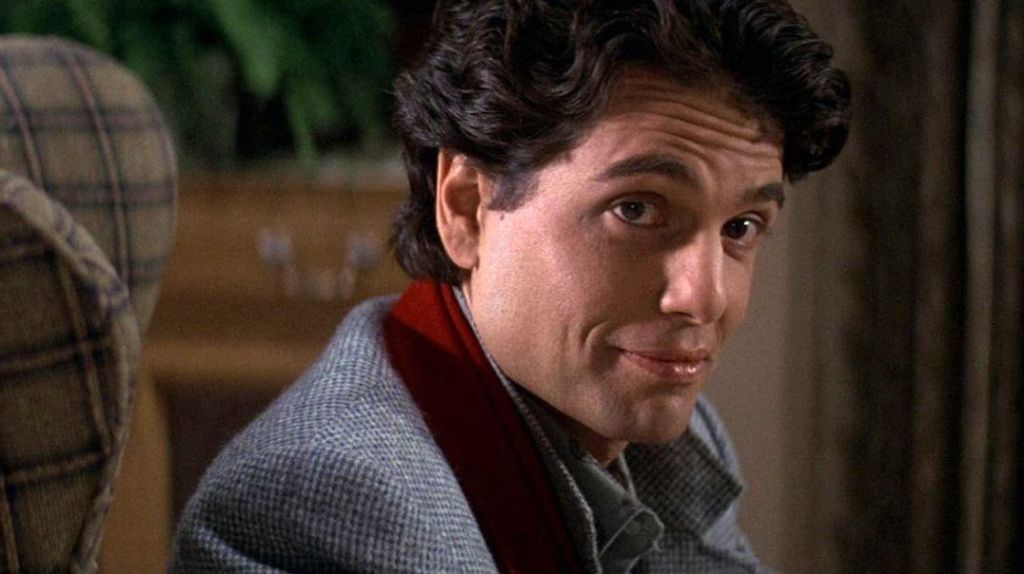
Chris Kaine is the most amateur film essayist whom you may ever imagine. He earnestly contends that he was named after the actor Chris Sarandon, because he was either conceived while his parents watched Fright Night (1985) in his paternal grandparents’ basement, or because of their love for The Princess Bride (1987), which stars a character by the name of “Humperdinck,” which is pretty funny, if you think about it.


Leave a Reply