email: latenightpickwick@gmail.com
Halloween may have come & gone, but November is never too late to celebrate some cinema that sees the specter of Death nipping at one’s heels. This month, the Pickwick looks back on films from the year 2006, at the movies for which the Drive-In remains very thankful.
No matter how scared of them one might be, there’s a relatively easy (yes, easy) way to begin going about watching horror films.
That’s the best news, right?
When I first discovered horror movies, they were a piece of cake. The monsters were easy to identify alongside the village’s angry mob, like spotting the unmistakable culprit in a police lineup. And monsters were so easy to understand as well. The simplicity of their evil wasn’t a matter of negotiation, and – in large part – the Universal monsters spoke to that understanding. At the age upon which I met those black & white characters on our home TV set, the monster’s identity never puzzled me. Clearly, the monster is the one with fangs who wants to drink your blood. The monster is the hairy one – also with sharp teeth – compelled to terrorize the small town.
And, yes, there was a bit of humanity to most of the so-called first cycle Universal monsters, but — by & large — these particular monsters were going to do more terrible than good things in the world.
Graduate from the OG monsters, and one might discover zombies or kaiju. There’s remarkably less humanity to these, and they’re still easily recognizable, as monstrous bad guys go. The monster is the skyscraper-tall creature stomping through Midtown. The monster is the animated corpse coming this way, and it wants to eat your flesh or your brains, depending on the filmmaker behind the picture. Perhaps you return to the original monsters – the vampires & the werewolves & such – though updated, in color, more violent. More is better, of course, but now there’s much less humanity. The werewolves of Dog Soldiers (2002) inspire no sympathy, nor do the vampires of 30 Days of Night (2007). Suddenly, the monsters are more recognizable than ever before: absolute nightmare fuel, in fact.
But then along comes writer-director Guillermo del Toro, and the horror world is upended altogether.
Yet del Toro’s vision of horror was not a flash in the pan. Pan’s Labyrinth would not be the only time that the filmmaker would cast monsters in a decidedly different light than the monstrous predecessors that had come before it.
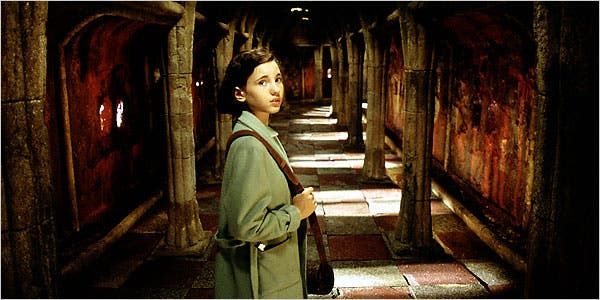
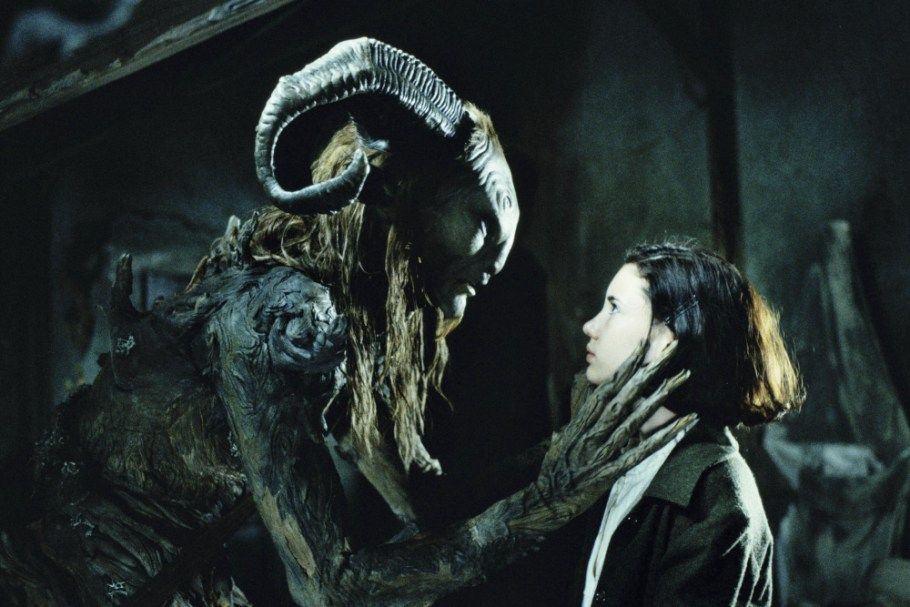
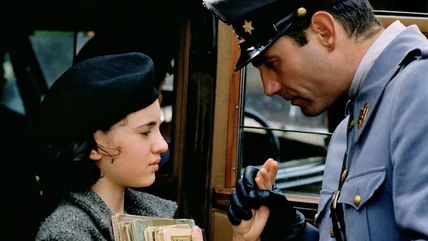
The film takes place in 1944 Francoist Spain, a world overrun by a political climate of war. And in this world, 10-year-old Ofelia (Ivana Baquero) travels with her pregnant mother Carmen (Ariadna Gil) to meet her new stepfather Vidal (Sergi López) – a Civil Guard officer of the Armed Police Corps who has been assigned to hunt down the Spanish Maquis – who executes his orders brutally, without question, and with no hesitation as he awaits the birth of his only son by Carmen. When Ofelia is lured into an underworld catacomb of fairies & monsters by an insect-like creature, Vidal’s housekeeper Mercedes (Maribel Verdú) tries to intervene, but when Ofelia is ultimately led into a labyrinth of mystical beings, she meets a nameless faun (Doug Jones) who assigns her a number of tasks in order to determine if she is, in fact, the reincarnation of Princess Moanna. Ofelia’s fate — whether mortal or otherwise — is inextricably linked to her potentially otherworldly heritage, as are the fates of those — whether good or evil — in Ofelia’s sphere.
Once upon a time, identifying a monster in a motion picture was so simple, either by its fangs or its fur or its ferocity.
Simple as that.
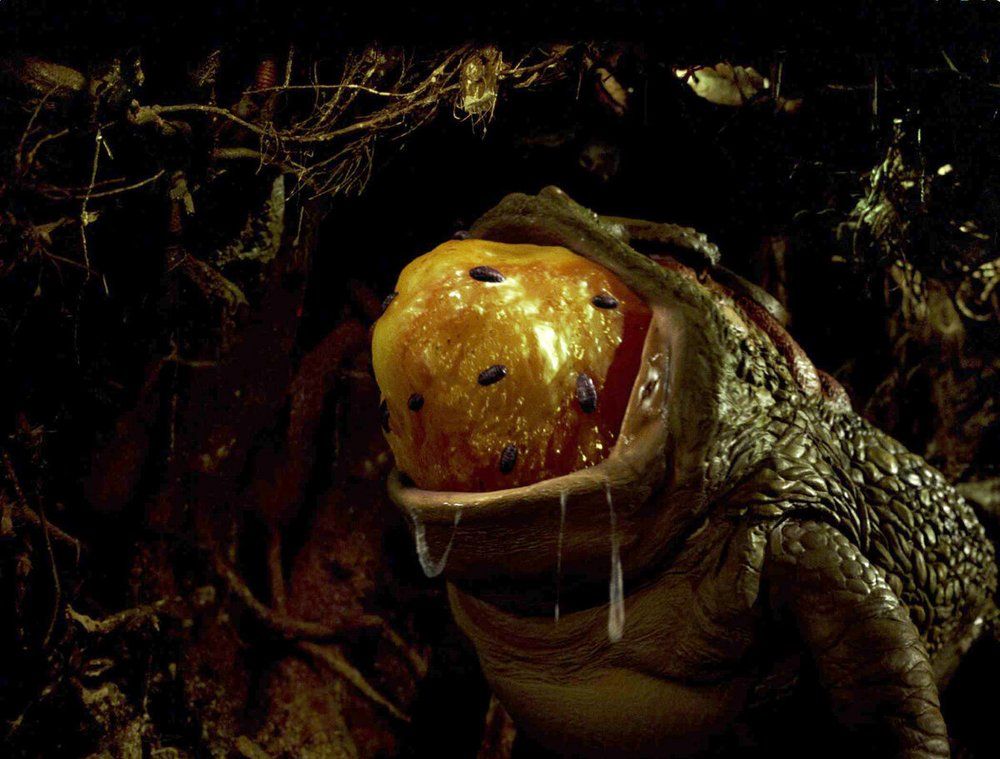
Identifying a monster was a simple movement from one particular origin point. It wasn’t a circuitous journey through a bewildering maze of shadows, flickering lights, sleight of hand.
In fact, identifying the monster in a movie was once simply a matter of watching as Lugosi’s vampire Dracula slowly descended upon the naked neck of his next female victim or of watching the 8th Wonder of the World King Kong ascend the Empire State Building.
It’s that simple.
It’s so simple as to not be unique in a Guillermo del Toro film, because – like so many, I would have to imagine – Pan’s Labyrinth was my introduction to del Toro & his storytelling methods. For someone reared on the Universal monsters, otherworldly invaders like Critters (1986) & Killer Klowns from Outer Space (1988), and Hellraiser (1987), the real monsters could be identified from a mile away.
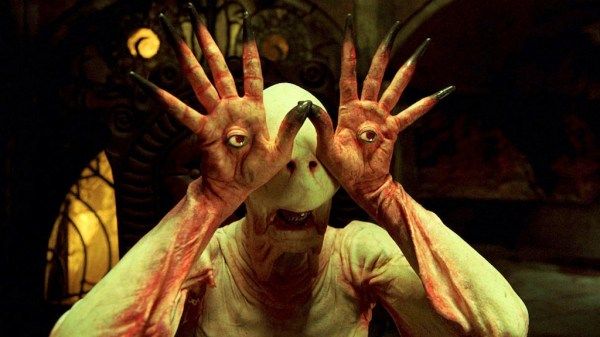
But Pan’s Labyrinth – and a labyrinth is a complex structure of passages, generally meant to disorient you – doesn’t subscribe to those definitions of horror. Populated with all manner of grotesque & disarming creatures, del Toro’s motion picture doesn’t cast the most discomforting characters as its villains but instead allows humans to play the role of the monsters.
Time & again throughout the picture, Vidal exhibits the most inhumane behavior against his fellow man, from brutally pummeling a farmer harmlessly hunting rabbits (then shooting to death his father) to assassinating his personal physician – because the doctor had euthanized a harmless prisoner of war. Vidal represents everything that could potentially be wrong with humanity, and del Toro explained in later interviews that what transpires in Pan’s Labyrinth is not only meant to mirror the fascist European landscape of the mid-1940s but also meant to mirror the post-9/11 landscape of America.
Man is the most capable creature under creation to demonstrate the characteristics most antithetical to Man, del Toro suggests, and the filmmaker illustrates that fact both through Vidal & the visually unsettling creatures that inhabit his film.
And though I recall sensing it when I saw Pan’s Labyrinth, del Toro certainly wasn’t the first to explore the notion that normal human beings could be more monstrous than any monster that humans could imagine. Ishirō Honda’s Godzilla (1954) remains a deceptively effective creature feature about the potential dangers of mankind’s control of nuclear power, disguised as a kaiju film in which an ancient, giant lizard-like monster parades across Tokyo. A little more than a decade later, George A. Romero’s Night of the Living Dead (1968) would utilize flesh-eating zombies as proxies for contemporary human life, commenting upon Western consumerism in Dawn of the Dead (1978) & unassailable militarism in Day of the Dead (1985). Almost two decades later, 28 Days Later (2002) – written by Alex Garland & directed by Danny Boyle – transformed the slow-moving flesheaters into sprinting spooks, despite the fact that the human beings who have survived this biochemical plague behave in ways that make the spasmodic, psychotic monsters rather incidental to more man-made horrors. Later still, AMC’s long-running zombie television series The Walking Dead (2010 – 2022) – created by comic book writer Robert Kirkman – certainly didn’t suggest that the flesh-eating zombies were nothing to worry about. But the series, in fact, demonstrated that the human survivors of this apocalypse would potentially be more deadly to one another than the mindless creatures that ambled throughout the light of day & the pitch darkness of night, across the American landscape.
What del Toro gets at with Pan’s Labyrinth, then, isn’t incredibly unique at all, whether through its utilization of monsters as things meant to demonstrate a real-world truth or through its manipulation of horror as a genre to demonstrate the same thing.
It’s been suggested that there are only three different stories — those of love, those of revenge, and those of war — to be told in the world.
But how someone tells those stories can remain so incredibly unique to be seemingly told from another world: the world of Guillermo del Toro.
And through its human performances, its score, its set pieces, its special effects, and – most notably – its heart does Pan’s Labyrinth look like a story that’s never been told, a thing of legend & myth that will likely outlive us all …
… And that’s the best news that one can receive when it comes to stories of monsters that demand destruction.
***



Leave a Reply