email: l8nightpickwick@gmail.com
1940 | NOT RATED | 95 minutes | d. Christy Cabanne | dp. Elwood Bredell | s. Maxwell Shane
In this multi-part series, the Drive-In examines sequels that one may have seen before the original film or films that came before it. Imagine seeing Toy Story 5 (2026) before any other Toy Story film — one would think that Jessie was the focal point of the entire franchise. See Scream (2022) before any other Scream film — and one would ask who final girl Sidney Prescott was in the first place. That’s where the Pickwick feasts on film.
Here, the Drive-In explores the second (or 3rd or 4th or 5th … ) chapter of a motion picture series, holding it up to the movie(s) that came before it, taking a close look at how the series got here, and, sometimes, where it was all headed.
This month, in its inaugural feature, the Drive-In unravels Universal Pictures’ 1940 motion picture horror film The Mummy’s Hand, taking a close look at the movie & the bandaged, apparently mindless monster that would become synonymous with future Mummy features, forever.
This screening may not be the first (or best) pick for a spooky cinema selection, but The Mummy’s Hand lurks behind an incredibly recognizable face perfect for a Halloween watchlist.
Of all the Universal monsters – watching them as I did, growing up – the Mummy un-thrilled me the most. Dracula, Frankenstein’s Monster, the Black Lagoon’s creature, and the Wolf Man were my first, and the slow-moving Mummy was simply late to the game.
The Mummy didn’t possess the supernatural powers of Dracula. It didn’t possess the speed & ferocity of the Wolf Man. It didn’t possess the child-like subterfuge necessary to lure you into plucking the heads from dandelions before he tosses you to your watery grave. The Mummy was simply slow – both in gait & cinematic premise. That the Mummy had the legs, so to speak, to survive as a franchise monster was a bit of a surprise to me, but there it was, eight years after Universal Pictures’ 1932 original film starring Boris Karloff.
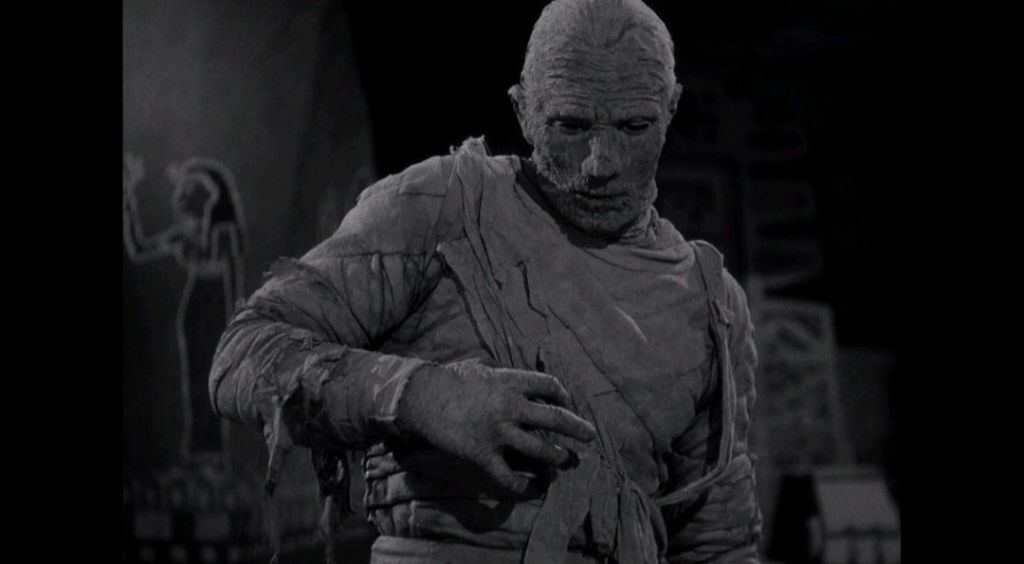
The second motion picture in the Mummy movie franchise, The Mummy’s Hand – not a direct sequel to Boris Karloff’s 1932 classic – finds two bankrupt American archeologists (Dick Foran & Wallace Ford) in Egypt, discovering clues that may lead them to the tomb of the Egyptian Princess Ananka, as well as the fortunes that rest with her body. Aided by a magician (Cecil Kellaway) & his daughter Marta (Peggy Moran), the duo discovers the tomb, only to be met by the high priest (George Zucco) & the living mummy (Tom Tyler) who guard it, ensuring a life & death confrontation for all time.
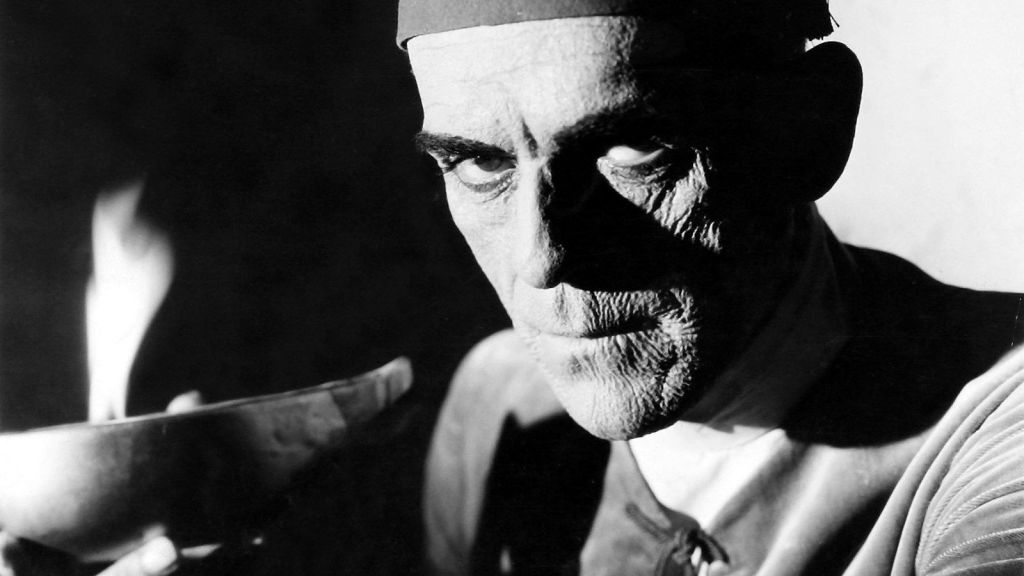
Many audiences obviously enjoy Karloff’s Mummy film over all others, but the movie’s universally recognized monster only appears in the motion picture’s opening credits.
The ubiquitous image of the bandaged Mummy wouldn’t assume its place fully in a Universal motion picture until The Mummy’s Hand, which I somehow saw as a child on cable television during Christmas week. I remember that I was training my young brain & body to resist sleep so that I could catch a glimpse od Santa Claus leaving me gifts on Christmas Eve, and I did so by sitting in the dark in my home’s TV room, the volume indecipherably quiet.
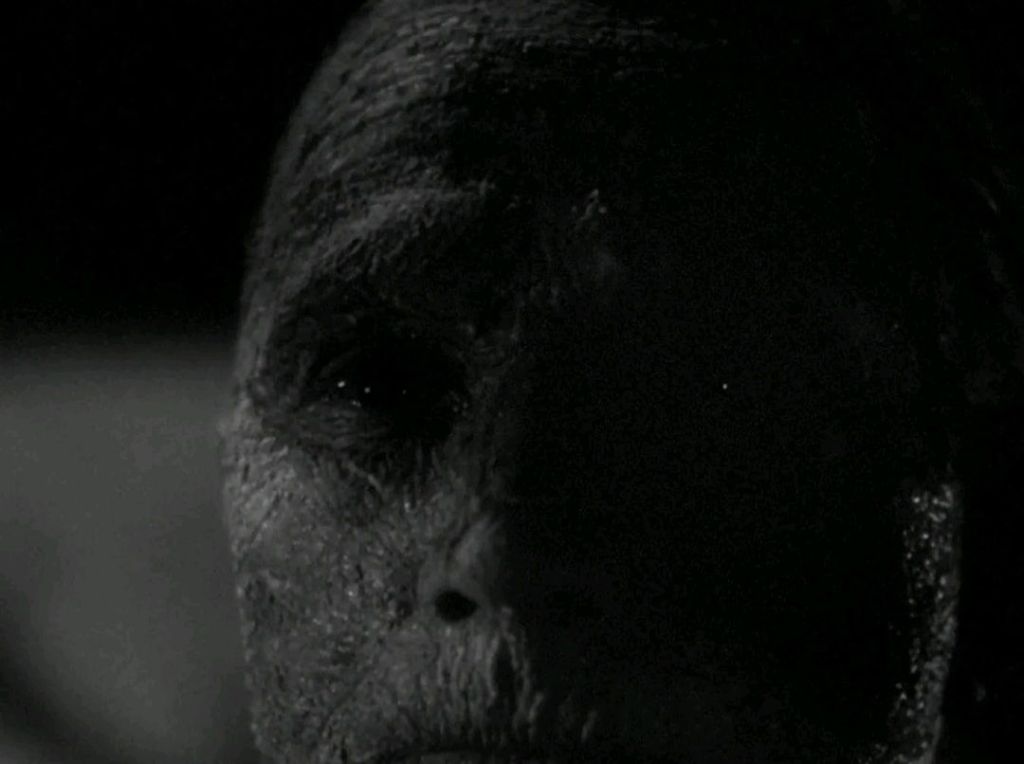
That’s when I saw it — black & white, soundlessly — when some network engineer apparently screwed up by screening a film so inappropriate for the holiday season.
But I didn’t care. With the captions on, I might as well have been transported back in time to watch a silent movie.
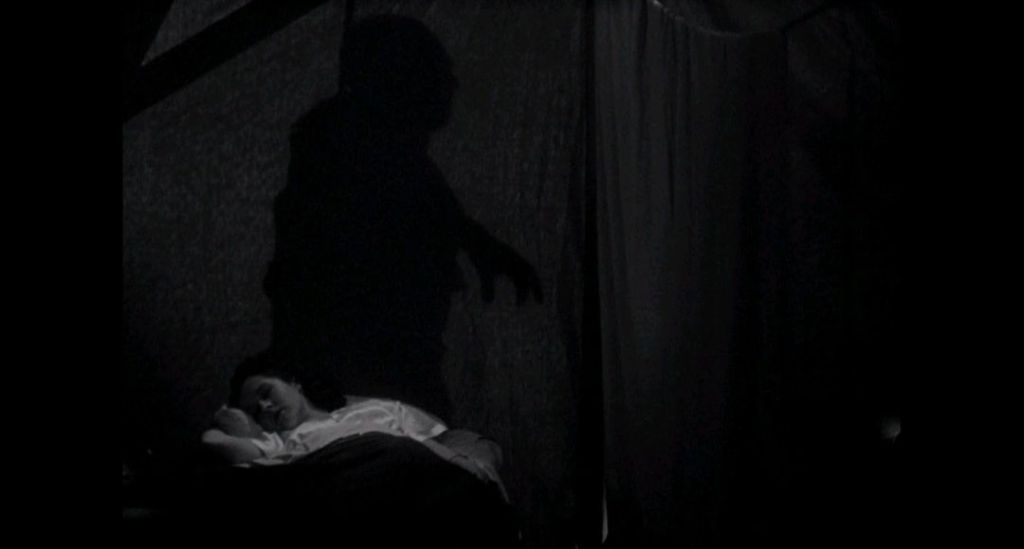
But by the time I saw the film, I was already more than familiar with Universal’s monsters, having seen The Wolf Man (1941), Dracula (1931), Creature from the Black Lagoon (1954), and Frankenstein (1931), in that order. For a while, I had no interest in seeking out the Mummy, because I knew enough of him that I was confident that a) I could outrun him, and b) there’s nothing scary about that confrontation. But the other films I’d seen – why, they were dark, moody, dangerous even, and bleak. So when I stumbled upon The Mummy’s Hand as I did, I half-hoped for the same thing.
And the movie would not be the same thing, because when the motion picture was originally produced, it was one of the second cycle of Universal monster movies, and everything I had seen until The Mummy’s Hand was a contribution to the studio’s first cycle, which concluded after the release of Dracula’s Daughter (1936). Just before filming on that picture had wrapped, the Laemmle family – together representing the heads of production on the monster films – lost the studio to the Standard Capital Corporation & Charles R. Rogers, who famously hated horror movies. Out of this Universal collapse came The Mummy’s Hand, which made at least one thing perfectly clear:
Yes, Charles R. Rogers hated horror.
As I watched The Mummy’s Hand, I looked forward to the bandaged, seemingly arthritic Mummy to amble onto the screen — even if I could outrun him — but for the first 40 minutes of the movie, I didn’t know (then) what the motion picture was supposed to be.
There was talk of an Egyptian expedition. There was some trepidation about that expedition. And there was humor, and — whether minimal or exploitative – humor wasn’t an ingredient in Universal’s first cycle of horror films, so it was strange at first to see so much humor in a Universal monster movie at all.
But more importantly, until minute 42 of the movie when the titular Mummy finally appears, the motion picture’s plot is too often ridiculous, relying on protagonists who generally come off as inept, the juvenile destruction of an ancient Egyptian vase, and a monster who mindlessly kills one character yet kidnaps another, perhaps as leverage. Today, I imagine The Mummy’s Hand had much to do with Rogers’ involvement in it, sharing so little of the first cycle’s DNA that one would doubt that the two cycles were even related by blood, and, for that reason, I had neither an interest in watching the subsequent Mummy pictures for quite some time.
On the other hand, I finally saw Karloff star in the 1932 “original,” and it could not be more different from the silent movie that I watched while training myself to ambush Santa Claus. Once more, when I saw the picture, I was surprised that the bandaged Mummy only appeared in the film’s opening credits. One would think that the long-lasting image of that iteration of the Mummy would have played a more substantial role. (Yes, Karloff’s menacing visage alone is worth the picture’s price of admission – it may even be a fair trade for the bandaged Mummy that somehow steals the real estate of movie posters & physical media releases.) But the iconic imagery of the Mummy alone didn’t separate the 1932 and the 1940 films. The Mummy’s Hand is an altogether reboot of the Mummy mythology, continuing into The Mummy’s Tomb (1942) as a legitimate sequel. If nothing else, Tomb is evidence that the Mummy’s lackluster defeat in Hand was so pitiful as to be inconsequential. And – what’s more – the driving force of the Mummy, from Hand & Tomb onward, is so divorced from Karloff’s original that The Mummy (1932) and the divergent timeline of Hand onward compels one to prefer the 1932 horror film after all, despite its omission of bandages.
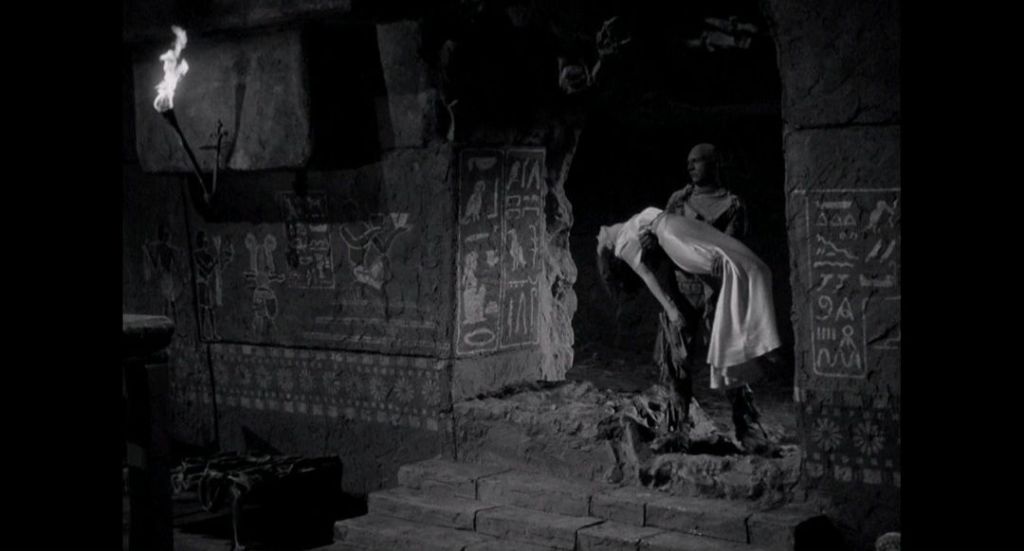
Because if there’s one thing that almost all of the first cycle Universal monsters have in common is that there is something tragic about them.
Frankenstein’s Monster didn’t ask to be regenerated as a dumbfounded creature alienated from the world. Larry Talbot was a victim of circumstance, having survived a werewolf’s attack, doomed to become a monster himself. The lagoon’s creature was content in his aquatic home until invaders breached its borders.
And in Karloff’s Mummy exists a story of generations-long tragic romance that the film’s anti-hero hopes to see concluded by reuniting with his true love, no matter the means or consequences.
The Mummy’s Hand entirely lacks that emotional component in its storytelling, opting instead to turn the monster into a mechanism, a soulless thing without history or cognition. This suggests, ultimately, that means have consequences. Admittedly, there is something about the Mummy’s 1932 film that remains forgivable, the story of a frustrated lover who will commit evil acts in order to rediscover his beloved, something heartening in that display of desire & depravity. But as Karloff’s Mummy indicates, means have consequences.
True love, then, isn’t too different from moviemaking. In moving from one film to its sequel, a filmmaker may have heartfelt intentions …
… But means have consequences, and the audience generally bears the weight of them when it comes to movies.
* * * *
The Mummy’s Hand is streaming on Amazon Prime.

Chris Kaine is the most amateur film essayist whom you may ever imagine. He earnestly contends that he was named after the actor Chris Sarandon, because he was either conceived while his parents watched Fright Night (1985) in his paternal grandparents’ basement, or because of their love for The Princess Bride (1987), which stars a character by the name of “Humperdinck,” which is pretty funny, if you think about it.


Leave a Reply