
email: l8nightpickwick@gmail.com
In anticipation of this feature, I’ve been poring through my motion picture memory, revisiting films that focus on religion & faith – and there’s a big difference between the two – all those films that somehow focus on God, whoever She is.
Understand that I grew up watching “religious” films only at my grandparents’ place, on Easter, as dinner was prepared for the family. And each year, it was The Ten Commandments (1956), always with commercials. And while I was in high school, I was told to read Bible stories as much as Shakespeare – “They’re the most referenced stories in literature,” I was told. Shakespeare was difficult if only for the language. But it was ultimately three stories over & over & over again: love, revenge, and war. Meanwhile, the Bible was more complicated.
A Shakespearean tragedy takes no more than four hours to perform onstage by a really ambitious local theater troupe, but the Bible spans eons — it would seem — and I didn’t have time for that.
Having read a handful of the Good Book’s stories & seeing some as allegories in some of the literature that I was reading and in some of the movies that I was seeing, I revealed these Biblical symbols in motion pictures, short stories, poetry, and novels to my mom as if I was the wholly (but not holy) interpreter of theology in pop culture & young adult literature.
Shortly thereafter, Mom took me to see The Passion of the Christ (2004) – the 2+-hour hate crime against the King of the Jews – when it played in theaters. “This might get violent,” she told me, “but this is the stuff they don’t teach kids in Sunday school.” I don’t know if she was right – I’ve never attended Sunday school.
Then, my uncle took me to see Constantine (2005) in the theater. “You’ll bloody love this,” he said to me in his worst Cockney brogue as we took our seats. But that movie’s a bit robbed of the British accents & London fog that its comic book counterpart possesses, more scorched with super heroics than with the sin, saintliness, and Satan of something like Ben-Hur (1959).
From there, the matrimony of faith & film seemed less invasive, and the motion pictures start to overlap in my memory. I saw Always (1989) at home with Mom as she baptized me with Spielberg, and I saw The Exorcist (1973) at home because of my uncle. And because – well, Friedkin. And I saw All Dogs Go to Heaven (1989), also at home with my grandparents, for no memorable reason.
Sweet Jesus.
The good Lord seemed omnipresent in the movies that I watched but absolutely absent from the life that I lived away from the small or big screen.
My mom’s parents attended church only for Easter Sunday & Christmas Eve services, but nothing I read further of the Bible compelled me to visit that so-called particular end of town, even though Mom asked me once or twice if that was a particular field trip that I would like to make, even despite her reluctance to go once she was pregnant with me. And – unlike Noah – that turned out to be a pilgrimage that I didn’t want to undertake.
To my thinking, it would have been a bit sacrilegious had I wandered into church at all – “It’s a nice place to visit,” you know? “But I wouldn’t want to live there.” And I’m certain that if I ever visited a house of worship, I’d be welcomed by very charming believers. But as I admired the artwork & the architecture & the echoing quiet & the solemnity of that place, I’d feel like someone was going to hand me a pamphlet introducing me to the possibility of financing a timeshare, and – while the Lake Michigan shoreline is a gorgeous thing to see – I’m not interested in being locked into staying there.
That would be Hell.
I had a similar sensation when I visited Walt Disney World as a 12-year-old during spring break. A “cast member” – as they’re called – in a souvenir shop tried three times to put Mickey Mouse ears on my head, against my resistance. Ultimately, I pushed him into a rack of fucking goofy t-shirts. Not fucking Goofy t-shirts. Just fucking goofy t-shirts. I dig the music that they play there & all, and their costumes are entertaining, but I don’t need to walk around with evidence hanging from my neck that the place is momentarily neat.
I suppose 50% of it — earnestly watching religious films — was about an intolerance for proselytization, of being lectured or “sold” on Christianity. And I suppose the other 50% was about the sense of guilt that I’d feel, that I shouldn’t be in church if I wasn’t going to take it seriously.
Religion, church, and faith — like Walt Disney World — require a buy-in, an amount of cosplay & performance & commitment that I simply cannot muster.
Maybe that’s why Mom stopped going to church – even for special occasions – despite the fact that we annually celebrate the commercialized “Santa Claus Edition” of Christmas and we watch a religiously-themed film on Easter Sunday to this day. Perhaps Mom discovered that she could no longer afford to visit her neighborhood Walt Disney World, while she was a single mother, carrying me.
Perhaps we’d both rather have Chinese take-out & watch Die Hard 2 (1990) or It’s a Wonderful Life (1946) on Christmas Eve. Or perhaps we’d both rather watch The Golden Child (1986) or Life of Pi (2012) over ham sandwiches & potato chips on Easter Sunday.
But when I first discovered writer-director-Silent Bob star Kevin Smith, I never imagined his filmmaking would take me beyond the mortal plane, that a movie could make me confront my relationship with The Book. Smith’s movies were for pop cultural potheads, not for big screen Bibliophiles.

Clerks (1994) was my first Kevin Smith film, and I simply didn’t get it. That’s not to suggest that I didn’t like it. I’d read about the making of the movie & how it cost as little as the price of two cars in 1994 and all that. I just didn’t get it, probably because it was clogged with these tangential conversations about pop culture & inanity that sounded too much like I was listening to my mom & my uncle talk about anything. If anyone had told me that you could make a movie about the merits of the red & blue Spider-Man costume versus the symbiote-black Spider-Man costume, I would have never believed you – but that was Clerks. And — at least, then — I didn’t believe that you could make a movie like that.
Then came Chasing Amy. “You’ll like this one,” Mom told me. “It’s about comic books.” But it wasn’t. It had nothing more to do with comic books than Clerks had anything to do with discussions about the death toll of contract construction workers in Return of the Jedi, but my brain wasn’t wired then for films that flirt with the banality of convenience store life & the hilarity of discovering how many blow jobs your girlfriend has performed in her lifetime. My brain wasn’t prepared then for movies that confront the complexities of human sexuality & the silly, Jaws-based references to injuries you’ve earned, mid-coitus.
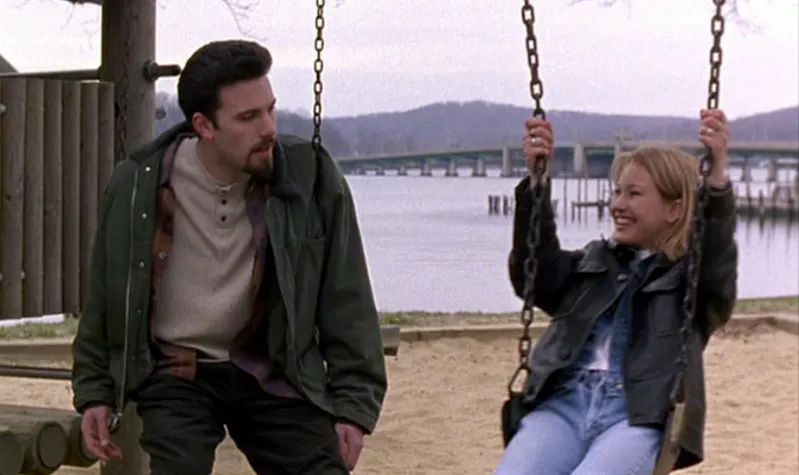
And I don’t recall how much I’d changed as a person or as a film fan after seeing Clerks & Chasing Amy and before seeing Dogma (1999), but Smith’s third film begged me to get some religion. And now that a sequel to the movie is – like the Second Coming – promised to us, I’m thinking more & more about the original film.
In a post published by @scifinowmag, Smith contends that the sequel will approach the subject of Dogma in a creatively different way, from the perspective of the writer-director himself. In 1998, Dogma was directed by a filmmaker (Smith) who was not undergoing a crisis of faith, telling the story of Bethany, who was overwhelmingly alienated from a belief in God. In the sequel, Smith appears to promise that the motion picture comes from the heart of a filmmaker (Smith) who may not have a lot of faith in his reserves.
Where Dogma is concerned, the comedically controversial movie remains an extension of Smith’s View Askewniverse insomuch that when two fallen angels – Bartleby (Ben Affleck) & Loki (Matt Damon) — discover a loophole in Catholic dogma allowing them to re-enter Heaven but in doing so end all existence, stoners Jay (Jason Mewes) & Silent Bob (Smith) join a disillusioned Catholic abortion clinic clerk named Bethany (Linda Fiorentio) who’s been told that she must stop the angels from doing so, aided along the way by Jesus Christ’s 13th Apostle Rufus (Chris Rock).

This by no means suggests that Smith’s later films – Jay & Silent Bob Strike Back (2001), Jersey Girl (2004), or even Zack & Miri Make a Porno (2008) – delivered to me some profound understanding of myself. Dogma didn’t illuminate, for me, how Bible stories so forever entrenched in literature from long ago or in motion pictures today could somehow elevate audiences.
But, truly, Dogma demonstrates through its narrative that it’s not important what one believes – meaning, a belief in a single theological doctrine, like Buddhism, Judaism, Hinduism, Christianity, etc. – but that one simply believes. As the muse Serendipity (Selma Hayek) tells Bethany, “It’s not about who’s right or wrong. No denomination has nailed it yet, because they’re all too self-righteous to realize that it doesn’t matter what you have faith in – just that you have faith.
“Your heart’s in the right place,” Serendipity promises, “but your brain’s got to wake up.”
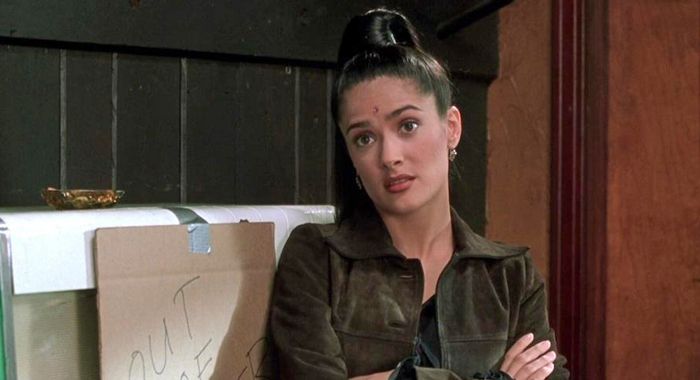
From there, a fecal matter demon intrudes upon a titty bar, two arrogant angels are cast out of a fast-moving passenger train, and many innocent people are slaughtered outside of a Catholic church, but not before Smith’s film hypothesizes that religion – or faith, whatever – is merely an idea of how the universe works. And ideas are good – Rufus the 13th Apostle admits – because ideas can change.
It’s harder, in the long-run, to change a belief, and that’s been the bane of humanity’s existence since the 7th Day. And – spoiler alert! – Jay & Silent Bob (alongside Bethany & Rufus & others) succeed in stopping the angels, thereby preserving existence.
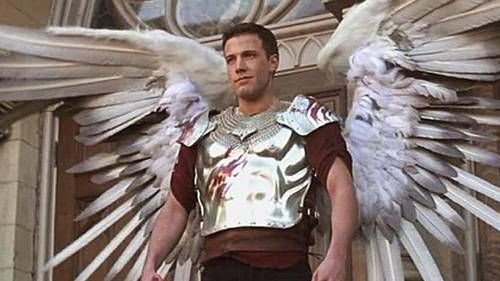
In the end, despite the inclusion of a demonic shit demon, Dogma says a lot to its audience, both without committing to a multi-hour physical assault on the Son of God & without committing to a runtime of almost five hours, which includes those commercials for worldly goods that we won’t take with us to the Hereafter.
Even from a religious standpoint, Dogma is a film – ultimately – about understanding who you think are, just as Bethany at first fully understood that she was a Catholic suffering from a loss of faith. But Dogma is also about understanding the person whom you’d never think you could be, just as Bethany struggles to comprehend her role in preserving existence by stopping two fallen angels from entering a Catholic church in New Jersey. And – finally – it’s a film about understanding what you will ultimately become, accepting it, as Bethany’s long-lamented wish for a child of her own when she is granted the divine motherhood of the Last Scion.
What’s interesting about these three life lessons — and the Bible is obsessed with the number three — is that they’re illustrated so humanly through a text & an ideology that I never thought that I could understand, demonstrated through a world of which I never imagined could exist.
“Are you saying you believe?” Rufus may ask, as he does in the final moments of Dogma.
And, “No,” Bethany would respond. “But I have a good idea.”
Dogma didn’t gift me a passport to visit my neighborhood Walt Disney World, but the film taught me that I’m welcome to learn something through the church about myself, even if I have no intention of buying something from the souvenir shop, as evidence that I was there.
It also taught me that you can learn a lot from potheads beyond tangential discussions of Star Wars, about human sexuality, and of even demonic shit demons.
Now that’s an idea.
Sweet Jesus, indeed.
* * * *
Dogma is streaming for rental & for purchase on platforms like Amazon Prime & Fandango.
Chris Kaine is the most amateur film essayist whom you may ever imagine. He earnestly contends that he was named after the actor Chris Sarandon, because he was either conceived while his parents watched Fright Night (1985) in his paternal grandparents’ basement, or because of their love for The Princess Bride (1987), which stars a character by the name of “Humperdink,” which is pretty funny, if you think about it.


Leave a comment