
email: latenightpickwick@gmail.com
This month, the Pickwick looks back on films from the year 2005, movies for which the Pickwick remains thankful.
Like so many Batman fans, my Batman looked like Michael Keaton. My Batman wore a stiff, rubber suit, rendering himself incapable of turning his head from right to left. Looking up at the starless Gotham skies was a seemingly impossible task for my Batman.
My Batman was the Batman handed down to me by my uncle, and my Batman – even as his everyday alter ego Bruce Wayne – was ready to get nuts.
It was the first thing that occurred to me when my uncle sat me down in front of Tim Burton’s Batman (1989), because I’d seen Mr. Mom (1983), but Mr. Mom got nuts about automobile drop-off points at the elementary school, about coupons, about dirty diapers, and seemingly sentient vacuum cleaners. Mr. Mom never got nuts about fighting city-wide psychotic crime.
So let’s get nuts.
Before I was 10, my uncle had introduced me to the small screen escapades of Batman & Robin that aired on CBS, starring Adam West & Burt Ward. Those bite-sized, television-sized adventures were brightly technicolored, riddled with eye-rolling riddles and campy in their crimefighting solutions and their hand-to-hand action sequences. And – at that age – that particular world of superheroes was enough for me.

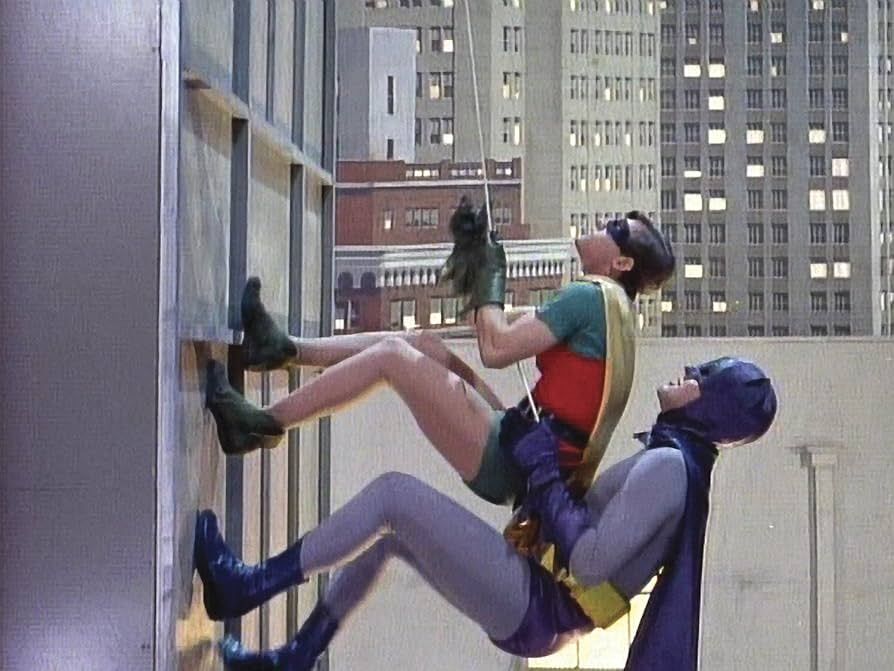


Batman — which aired for three seasons from 1966 to 1968 on CBS — starred Adam West, Cesar Romero, and Burt Ward, among others. Promotional photos courtesy of CBS.
But when I saw director Tim Burton’s Batman (1989), the Caped Crusader would never be the same. Gone was the Batman of the perfectly-choreographed skyscraper ascension and the Batusi. Gone was the Batman of the BIFF POW SLAMMO hand-to-hand street fights. For at least two & a half movies and three different movie stars, the Batwing had landed, for me.
And for a while, Burton’s serrated Gotham City skyscrapers and composer Danny Elfman’s moody score were the perfect ingredients for the next chapter of the Dark Knight – my “Year Two,” if you will. And I wasn’t alone. From what I understand, Batman would launch the character into an unparalleled atmosphere – with or without the benefit of eyesight or echolalia. It was a theatrical blockbuster. It was a juggernaut of toy franchising. It was consumable even through the collectible glasses adorned with the film’s characters, purchased at McDonald’s with a value meal for just a few dollars more.
Like the 1978 iteration of Superman — directed by Richard Donner and starring Christopher Reeve and musically composed by John Williams — this Batman — of Tim Burton and Michael Keaton and Danny Elfman — would never be replaced.
Until director Christopher Nolan staked his claim on Gotham City, that is.
And when I first saw Batman Begins, I hadn’t seen Memento (2000), the neo-noir mystery of a man suffering from retrograde amnesia, who tattoos to his skin – before he forgets them – the clues that will lead him to his wife’s murderer. And I hadn’t seen Following (1998), the non-linear thriller about a novelist who follows local urban citizens for story ideas … only to discover that his following may have gone too far.
Had I seen these films, perhaps I could have anticipated what I would make of this Batman, but I hadn’t. I wasn’t prepared for Nolan, and I wasn’t prepared for this Batman. Nolan’s film tells the story of a young Bruce Wayne (Christian Bale) who hasn’t been playing as Batman for long. In the opening moments of the motion picture, having defeated other street-level thugs, Batman defeats an inexperienced Scarecrow (Cillian Murphy). The inexperienced Caped Crusader is prepared to assume his role as Gotham City’s savior until the mysterious Ra’s Al Ghul promises to bring Gotham to the ground. What follows is some world-building for the Dark Knight, until Batman must finally choose between the training that has defined him and the fate of Gotham City itself.
But — unlike comic book fans who may be startled by a sea change in their favorite franchise — I didn’t feel a sense of loss for the 1960s Batman TV buffoonery, nor did I feel a sense of loss for the 1990s neo-noir Batman landscapes.
I found Nolan’s Batman more compelling than those who had come before him. Each new cinematic silhouette of the Batman seemed more attractive than the one before it.
But I didn’t understand how progressive the storytelling could be until Batman Begins.
Here, Bruce Wayne was more haunted by the murder of his parents than ever before, never explored in the 1960s television series and only glimpsed at in Burton’s 1989 motion picture. This isn’t to suggest that CBS’s TV program was somehow a failure nor that Burton’s blockbuster was a failure, but Batman Begins simply remains the next chapter of a very specific, new life in the Caped Crusader’s cinematic career, leading to The Dark Knight (2008) and The Dark Knight Rises (2012). The dark realism of this trilogy led to Todd Phillips’ Joker (2019) – which ultimately disregarded the Batman mythology as canon – and certainly led to what could be called a franchise reboot with Matthew Reeves’ The Batman (2022).


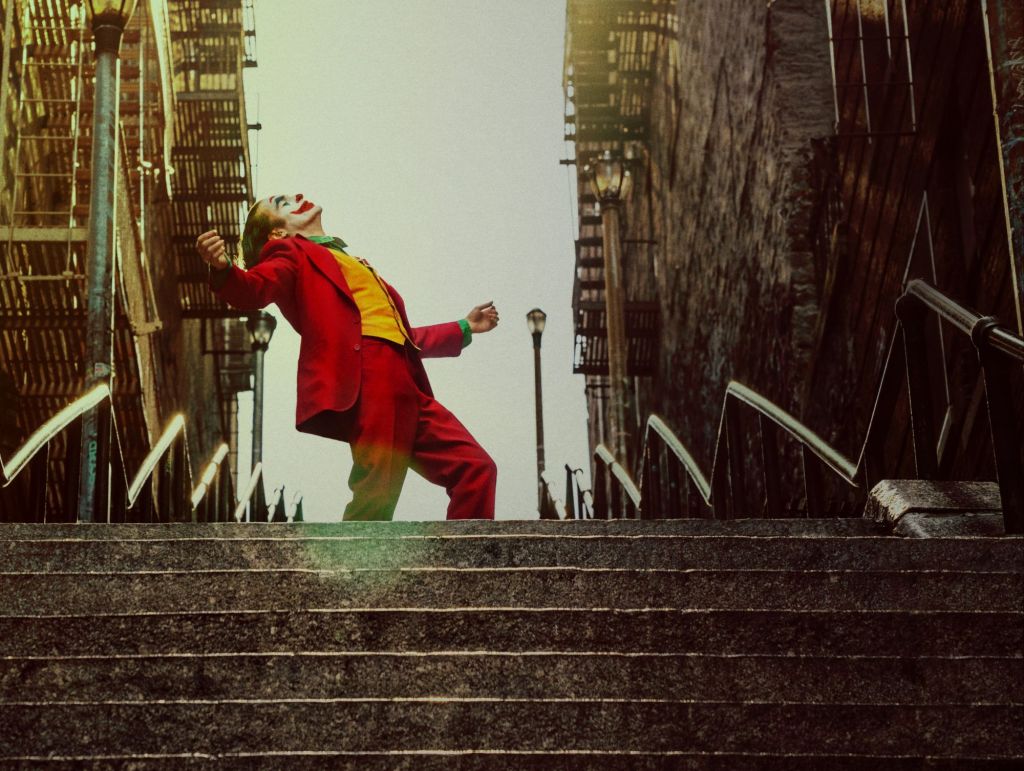

But where the 1966 Batman film embraced the camp of the small screen and the 1989 film attempted to modernize Batman for (then) contemporary audiences, Batman Begins remains one of the best representations of the potential for this singularly unique hero, at that time, in that moment.
And, at any time, as Commissioner Gordon states in The Dark Knight, “[Batman is] the hero Gotham deserves.”
And in 2005, that Batman was a thing to behold, indeed.
The film taught me not to cling so tightly to the dogmas that I had imagined as unbreakable with each new re-invention of the character. Just as I had moved on from the small screen glam of the 1960s Batman, I had moved on from the blatant campy darkness of Batman in 1989. I would move on too from the animated TV series of the 1990s that held our attention for so long.
But Nolan’s Batman — or, rather, his alter ego Bruce Wayne — was more haunted, as he should be, by the brutal murder of his parents. The CBS TV series never delved into this aspect of Batman’s mythology, and Burton’s film only glanced at it by transforming Bruce Wayne’s past in order to create a narrative in which Jack Napier — who would one day becomes the Joker, some 15 or 20 or 25 years later — would be unmasked as the killer of young Bruce’s parents. The revelation is only diminished by the fact that Michael Keaton’s Bruce Wayne only appears to emotionally mourn the murder of his parents once in the 1989 film. Before Nolan, there was never enough pathos to justify the transformation of Bruce Wayne into Batman. But in Batman Begins, audiences saw Bruce Wayne overwhelmed with anguish — even so many years later — over the loss of his parents. It is a loss that he carries with him daily. It is a loss that informs his every decision, every movement of his being.
It’s the humanity of Nolan’s Batman that made the film so authentic to me …
… Despite the fact that I knew — somewhere within me — that I would move on from Nolan’s Batman as well. It would only be a matter of time.
With its complex villains and its compelling supporting characters, Batman Begins today still represents a fresh restart of the cinematic franchise – indicating that the next chapter of Batman films was only the beginning …
… And it wouldn’t be the last.
That — too — was only a matter of time.
***
 Late-Night at the Pickwick Drive-In
Leave a comment